
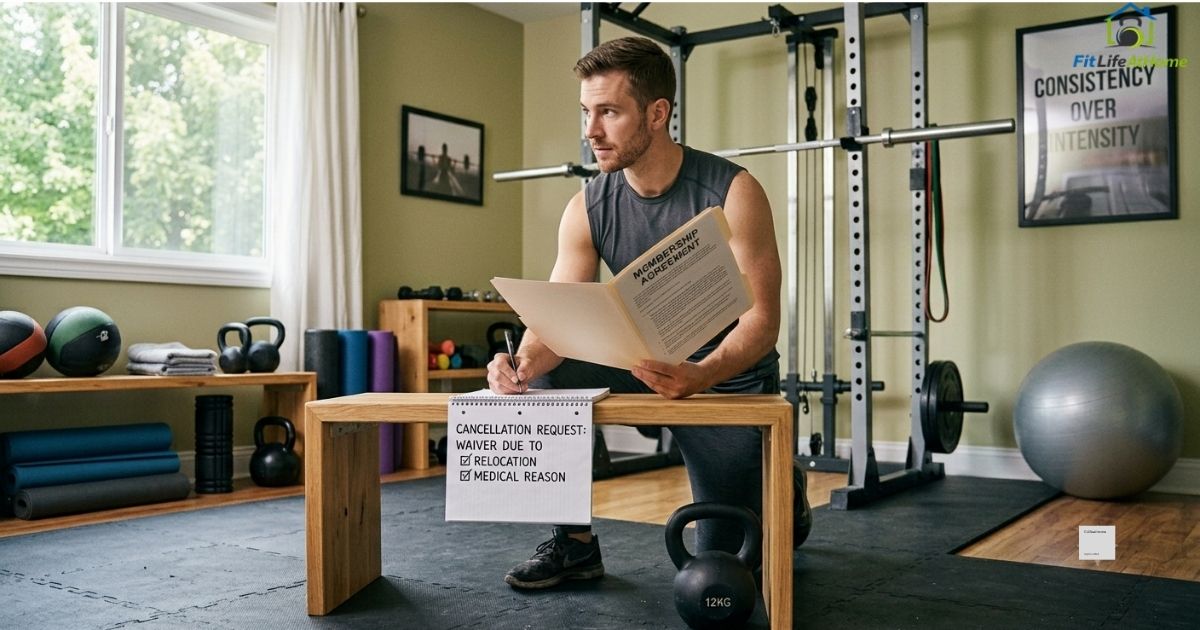
You can cancel your Anytime Fitness membership without paying a fee in one of two situations: your initial contract term is already finished (so you’ve rolled onto a month-to-month plan and only owe standard notice), or you qualify for a fee waiver. The three waivers that clubs honor are a long-term medical condition that prevents you from exercising, a move outside your club’s service area, and active-duty military orders. If you’re still inside your committed term and none of those apply, you’ll likely owe an early-termination fee — but there are legitimate ways to shrink it or skip it.
Here’s the part that trips people up: every Anytime Fitness club is independently owned, so there’s no single “cancel” button and the real rules live in your specific agreement. This guide walks you through finding your fee-free path, filing the cancellation so it actually sticks, and what to do if the gym ignores you or keeps charging your card.
Quick note: If you actually belong to Workout Anytime, that’s a different company with a different process (usually through its app). Make sure you’re cancelling the right gym.
Why You Can’t Just Click “Cancel”
Anytime Fitness runs on a franchise model. Your membership is held by your home club — the location where you signed up — and that club, not a corporate hotline, handles your cancellation. Most clubs require you to cancel in person or by certified mail, not through a website.
The other thing that decides everything is which type of membership you have:
| Membership type | Fee to leave early? | What you need to get out |
| Month-to-month (no commitment) | Usually none | Proper notice (often 30 days) |
| Fixed term (commonly 12 months) | Yes, if you leave early | A waiver, finish the term, or pay the buyout |
| Prepaid / paid-in-full | Varies | Check for refund terms; often just lapses |
When people say “it depends,” what they really mean is that your contract is the rulebook. So that’s where we start.
Can You Cancel Without a Fee? Find Your Path in 30 Seconds
Run yourself through this:
- Is your initial term already over? If yes, you’re month-to-month — no early-termination fee. Just give written notice and you’re done.
- Still inside your term? Then ask whether you qualify for a waiver: moving out of range, a long-term medical issue, or military orders. Any one of those means fee-free with the right paperwork.
- In your term with no waiver? You’ll probably owe a fee — skip to “How to Pay Less (or Nothing) Anyway.”
| Your situation | Fee? | Where to go |
| Initial term already over | No | File your notice |
| In term, but moving / medical / military | No, with proof | Pick your waiver below |
| In term, no waiver | Likely yes | Minimize the cost |
Before You Cancel: Find These 4 Numbers in Your Contract
Dig up your membership agreement — it’s usually in your sign-up email, the member app, your ABC Fitness account, or available on request from the club. Then pull out four things:
- Your initial term end date — when does the commitment actually end?
- The required notice period — 30 days is typical, but check.
- The required cancellation method — in person, certified mail, or both.
- The early-termination fee — a flat amount, or based on your remaining dues.
Can’t find your contract? Email the club and ask for a copy in writing. Honestly, that single habit — putting every request in writing from the first message — is the best thing you can do on this whole topic, because it builds the paper trail you may need later.
The 4 Fee-Free Ways to Leave Anytime Fitness
| Path | Who qualifies | Proof required | Outcome |
| Term ended | Anyone past the initial term | The dates | No fee |
| Relocation | Moving beyond your club’s range | Lease, utility bill, mortgage, or employer letter | Fee waived/reduced |
| Medical | Long-term condition preventing gym use | Physician’s note | Fee waived |
| Military | Active-duty with qualifying orders | Official orders | Fee waived |
Path 1 — Your Initial Term Has Ended
This is the easy one. Once your committed term lapses, you typically owe no early-termination fee and only need to give proper notice (usually 30 days). One trap to watch for: some agreements auto-renew you into a new fixed term. Check for that clause before you assume you’re free.
Path 2 — You’re Moving Out of Range
If you move far enough from any Anytime Fitness location, the fee is usually waived (the chain’s worldwide access is exactly why distance matters — clubs assume you can use another branch). Thresholds vary by club, often somewhere around 25 miles, so confirm yours. Bring proof: a signed lease or mortgage, a recent utility bill, or an employer relocation letter. Moving abroad is the strongest version of this case, since you’re outside the network entirely.
Path 3 — Injury or a Medical Condition
A documented condition that stops you from using the gym can qualify you for a fee-free exit. You’ll generally need a physician’s note on letterhead, dated and signed, that says you can’t exercise and notes how long that’s expected to last. Don’t assume it has to be literally permanent — many clubs accept long-term or indefinite restrictions. If your injury is temporary, freezing (covered below) is usually the better move.
Path 4 — You’re Active-Duty Military
This one is stronger than most people realize. The Servicemembers Civil Relief Act (SCRA) — a federal law — was amended to specifically include gym memberships among the consumer contracts you can terminate. According to U.S. Army legal-assistance guidance, the right applies once you receive military orders to relocate or deploy for 90 days or more to a location that doesn’t support the contract, and the provider can’t charge an early-termination fee. Dependents may also qualify. Just submit a copy of your orders with your cancellation. Some states add their own, sometimes broader, protections.
How and When to File So It Actually Sticks
In Person vs. Certified Mail
| In person | Certified mail | |
| Proof you get | Dated, signed copy of the form | USPS delivery confirmation + signature |
| Best when | You can reach the club in staffed hours | You can’t get there, or want airtight proof |
| Main risk | A verbal-only request leaves no record | None, if you keep the receipt |
My honest advice: even when in-person is allowed, certified mail is worth the few dollars, because a signed delivery receipt is the one thing a club can’t argue with later.
Whichever you choose, include all of this:
- Full name (as it appears on the account)
- Membership / contract number
- Your home club’s name and address
- A clear line: “I am cancelling my membership, effective [date].”
- A request for written confirmation and your final billing date
- Your signature and the date
- Any waiver documentation
Two things to know. First, the club handles your cancellation — ABC Fitness only processes payments and billing disputes, so don’t waste time asking them to cancel for you. Second, expect a retention pitch. Staff may offer a freeze, a discount, or a downgrade. You’re allowed to politely decline and proceed; they can offer, but they can’t block your cancellation.
Time It So You Don’t Pay for an Extra Month
Here’s the part nobody explains. Say your club drafts on the 1st and requires 30 days’ notice. If you give notice on the 2nd, that 30-day window stretches past the next draft on the 1st — so you’ll likely pay one more month, then the membership ends. The lesson: with a 30-day notice and monthly billing, budget for one final payment, and give notice as early as possible to avoid getting caught for two. Always get the final date in writing.
Copy-Paste Cancellation Letter
[Your full name]
[Your address]
[City, State ZIP]
[Date]
Anytime Fitness — [Club name]
[Club street address]
[City, State ZIP]
Sent via USPS Certified Mail, Return Receipt Requested
Re: Membership cancellation — Account/Member #[number]
To the Manager,
I am writing to cancel my Anytime Fitness membership at this location,
effective [date, or “at the end of my required notice period”]. Please
treat this letter as my formal written notice.
[If applicable: I qualify for a fee waiver due to (relocation / a
documented medical condition / active-duty military orders).
Supporting documentation is enclosed.]
Please do not renew my membership automatically. Please send written
confirmation of this cancellation and my final billing date. I do not
authorize any charges after my final billing date and will dispute any
that occur.
Thank you,
[Signature]
[Printed name]
Enclosures: [list documentation]
Don’t Qualify for a Waiver? How to Pay Less (or Nothing) Anyway
If you’re stuck inside your term, do the math before you write a check. Reported early-termination fees vary a lot by location — commonly somewhere from around $75 up into the low hundreds — so compare your fee against what’s left on the contract.
| Option | Rough cost | Best for | Downside |
| Pay the buyout | The fee | Fee is less than your remaining dues | Upfront cost |
| Run out the term | Months left × monthly dues | Term is nearly over | You keep paying |
| Freeze | Free to a small hold fee | A temporary situation | Still tied to the club |
| Transfer | Often no fee | Someone will take it over | You need a taker |
Simple rule: if the fee is less than your remaining dues, buy out and walk. If it’s more, run out the term — or freeze if your situation is only temporary.
Freeze vs. Cancel: Which Should You Choose?
- Freeze if: a short injury, travel, a tight month — anything where you’ll be back.
- Cancel if: you’re moving, your situation changed for good, or you’re simply done.
What to Do If the Club Ignores You or Keeps Charging You
This is where most guides go quiet, and it’s the situation that causes real frustration. If a club drags its feet, here’s the ladder:
- Lock down your paper trail — the certified-mail receipt, your dated form, screenshots, any confirmation.
- Dispute the billing with ABC Fitness in writing, referencing your cancellation date.
- Use your consumer-protection leverage. The FTC has been cracking down on gyms that make cancelling harder than signing up — it sued the operator of LA Fitness in 2025 over exactly that kind of practice. A short, firm letter noting this tends to get attention.
- Dispute the charges with your bank — but only for charges after your confirmed final date, and mind the credit note below.
- File complaints with the FTC (reportfraud.ftc.gov) and your state Attorney General. Many states also have automatic-renewal laws on your side.
A line that works: “I cancelled in writing by certified mail on [date], tracking #[…]. Charges after my final billing date are unauthorized. Please confirm cancellation and refund them, or I’ll file complaints with the FTC and my state Attorney General.”
This is general information, not legal advice — confirm your own agreement and your state’s laws.
7 Mistakes That Keep People Getting Billed
- Cancelling your card or bank draft first. This is the big one. It doesn’t cancel anything — it just makes you miss payments, which triggers fees and can hit your credit. Cancel the membership first; stop the draft only after your confirmed final date.
- Assuming “I stopped showing up” cancels it. It doesn’t. Billing runs until you give notice.
- Not getting written confirmation.
- Missing the notice window. Count back from your term end and file early.
- Sending regular mail instead of certified.
- Submitting at the wrong club instead of your home club.
- Ignoring an auto-renew clause that quietly re-locks you.
Myth-Busters
| Myth | Reality |
| “I can cancel online like Netflix.” | Most clubs require in person or certified mail. |
| “Cancelling hurts my credit.” | A proper cancellation doesn’t — only defaulting does. |
| “They can’t charge me if I don’t use it.” | Unused isn’t cancelled; billing continues. |
| “A gym can’t send me to collections.” | It can, if you default on what you actually owe. |
How 4 Tricky Cancellations Play Out
- Moved abroad, club ignores your emails. Send a certified-mail notice with relocation proof. If they still ignore it, work the escalation ladder above.
- Injured mid-contract. Long-term? Use the medical waiver with a doctor’s note. Temporary? Freeze instead.
- Joined at a club in a city you’ve left. It’s still your home club — cancel by certified mail to that location, or use the relocation waiver if you’ve moved far enough.
- Can never make staffed hours. Skip the in-person trip entirely and mail a certified letter with all your details.
After You Cancel: Prove It and Protect Yourself
- Get and save written confirmation with your final billing date.
- Watch your next one or two statements for any stray draft.
- Keep your records (letter, receipt, confirmation) for several months.
- Dispute any charge after your final date right away.
There’s a real difference between cancelling and being able to prove you cancelled. The proof is what protects you.
Frequently Asked Questions
Usually no. Most independently owned clubs require an in-person form or a certified-mail letter to your home club. Don’t count on a website cancel button.
Often it’s not accepted as the official method. A club may take the call, but you’ll still want written notice and written confirmation so there’s a record.
It depends on your contract and location. Reported early-termination fees range widely — often from around $75 into the low hundreds. Month-to-month members typically pay nothing with proper notice.
Generally yes. Your membership lives with your home club, so that’s where the cancellation goes.
One final draft during your notice period is normal. Charges after your confirmed final date aren’t authorized — dispute them.
Use the relocation waiver: a certified-mail notice plus proof of your new address, ideally beyond the club’s service range.
Usually not. Gyms generally don’t refund months you didn’t use — using the membership is on you.
Missed payments can mean late fees, collections, and credit damage. Cancel properly instead.
No — different company, different process (often via an app). Make sure you’re cancelling the brand you actually belong to.
Cancelling Anytime Fitness isn’t hard once you know which path is yours: finish your term or qualify for a waiver, file by certified mail, time it around your billing date, and keep proof. Do that, and you’re out — without an unwelcome surprise on your next statement.
Sources: Anytime Fitness club and FAQ pages (franchise and billing structure); U.S. Army legal-assistance and CFPB guidance on the SCRA; the FTC’s actions on gym-membership cancellation. Always confirm details against your own membership agreement and local law.