Can You Really Get Fit at Home? Yes With One Catch
For most people, your living room is enough. The official physical activity guidelines describe what your body needs, and they never mention a building. The CDC and WHO both recommend at least 150 minutes of moderate activity a week plus muscle-strengthening work on two or more days and the CDC says plainly that the strengthening part can come from bodyweight exercises or weights. The guidelines specify how often, how hard, and how long. Where you do it isn’t on the list. What actually drives results is the training stimulus effort, volume, and steady progression paired with doing it consistently. A barbell isn’t magic. Your muscles respond to tension and effort, wherever those come from. The catch: there’s a ceiling. Once your goal becomes maximal strength, heavy barbell squats, deadlifts, big bench numbers, bodyweight and light equipment can’t load you enough, and the gym wins cleanly. We’ll pin down exactly when that line arrives. For most people chasing “fit, strong, and lean,” it never does. The rule of thumb: the best place to work out is the one you’ll actually show up to. For most beginners, that’s home.Will It Actually Work for Your Goal?
“It depends on your goals” is technically true and completely useless. So here’s the real answer, goal by goal.| Your goal | Verdict | Why | When the gym wins |
| General fitness & health | Home wins | Guidelines are location-agnostic; consistency is everything | Basically never |
| Fat loss | Tie | Fat loss is calories, intensity, and diet — not location | Never (you can’t out-train a diet) |
| Build muscle | Home, for a long time | Muscle grows from tension and effort, not heavy load specifically | When bodyweight stops challenging you (see below) |
| Get toned & stronger | Home wins | Progressive overload works with bands, household weight, harder moves | Rarely |
| Maximal strength / powerlifting | Gym wins | You can’t safely load a heavy squat or deadlift with bodyweight | As soon as this is the goal |
| Sport performance | Hybrid | Depends on the sport’s specific demands | Sport-specific equipment |
| Mobility & flexibility | Home wins | Space and consistency beat machines | Never |
Home vs. Gym: The Real Differences (Including the Ones Nobody Mentions)
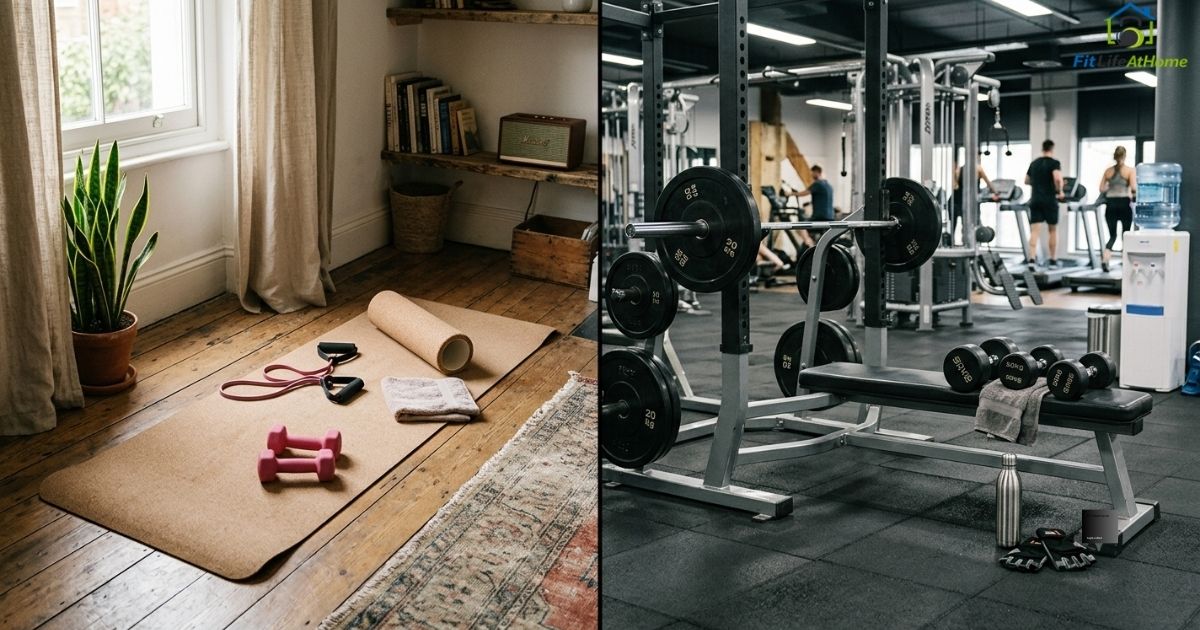
Forget the recycled pros-and-cons lists. Every option really comes down to two things: a friction (what lowers how often you train) and a ceiling (what caps your results). Home is low-friction, lower-ceiling. The gym is higher-friction, higher-ceiling. Pick the friction you can live with for the ceiling your goal needs.| Factor | Home | Gym | The hidden cost |
| Getting started | Roll out of bed and go | 20–40 min round trip | Gym: commute is time you pay every session |
| Cost | Free, or a one-time spend | Ongoing monthly fee | Home: gear that gathers dust. Gym: the membership you stop using |
| Progression ceiling | High, then it caps | Effectively unlimited | Home: no spotter for true max lifts |
| Learning form | On your own | Trainers, classes, staff | Home: easier to groove a bad habit |
| Motivation | Self-driven | The energy of other people | Home: distractions. Gym: anxiety that quietly cuts attendance |
| Focus | Household pulls at you | A dedicated “in the zone” space | Home: the line between life and workout blurs |
“But You Can’t Build Real Muscle at Home” — Let’s Kill That Myth
This is the belief that pushes people toward an expensive gym they don’t need, so let’s be precise. Muscle grows in response to mechanical tension and effort taken close to failure not to the brand of resistance. Research on resistance training shows that lighter loads taken near failure build muscle comparably to heavy loads, as long as you do enough volume. A push-up doesn’t know it isn’t a bench press. Your chest does the work either way.| The myth | The reality |
| You need heavy weights to build muscle | Effort and tension build muscle; heavy load is one route, not the only one |
| Home workouts are just cardio and yoga | Strength, muscle, power, and mobility all train at home |
| You’ll plateau within weeks | There are seven ways to keep progressing without heavier weights |
- Add reps
- Slow down the lowering phase
- Shorten your rest between sets
- Go deeper into each rep (fuller range of motion)
- Switch to a harder variation
- Train one limb at a time
- Add load with resistance bands or a loaded backpack
Why People Quit (and How to Not Be One of Them)
Both setups have a failure mode, and it’s almost never willpower. It’s friction you can design out.| If you train… | The mistake | The fix |
| At home | No boundary between life and workout | Same time, same spot, every session stack it onto something you already do daily |
| At home | “What do I even do today?” | Follow a set plan so there’s no decision to make |
| At home | Phone, fridge, family, TV | Clothes and mat out the night before, phone in another room |
| At home | Can’t tell if you’re improving | Keep a one-line log and chase a number |
| At the gym | The commute talks you out of it | Pick the closest gym; go straight from work, don’t pass home |
| At the gym | Intimidation, wandering aimlessly | Go off-peak, arrive with a written plan |
| At the gym | Paying but not going | Book sessions like appointments you can’t skip |
So Which Should You Choose?
Answer these six honestly:- Goal — general fitness, fat loss, or muscle? Or heavy max strength?
- Budget — is an ongoing fee comfortable, or is one-time (or free) better?
- Schedule — predictable, or all over the place?
- Motivation — do you self-start, or do you need people around you?
- Space — do you have a mat’s worth of floor at home?
- Comfort — does walking into a gym stress you out?
- Mostly home-friendly answers (free, unpredictable schedule, self-starter, have the space, gyms stress you) → start at home.
- Heavy-strength goal, money’s fine, you feed off gym energy, form-anxious → join a gym.
- A genuine mix → go hybrid.
- Put your days and times in your calendar right now
- Set a 5-minute “minimum workout” for bad days — one short circuit — so your streak survives low motivation
- If home: a 20–30 minute full-body session (squats, push-ups, rows, a hip hinge, a plank), three times
- If gym: go off-peak with a simple full-body plan written down, so you never wander
- Pick a check-in date about six weeks out to reassess
Yes, for a long time. Harder bodyweight variations and high effort drive growth. You’ll eventually want some added load, but that’s months away, not weeks.
When you can do 15+ controlled reps of the hardest safe variation of a movement and still aren’t challenged. Most people take a year or more to reach that point.
Yes. A yoga-mat-sized area covers nearly every bodyweight movement worth doing.
The risk is real but manageable: film yourself or use a mirror, progress slowly, and leave a rep in reserve instead of grinding to failure.
No. You can’t spot-reduce fat anywhere, and fat loss comes from a calorie deficit plus activity not from a specific machine.
The Bottom Line
The best gym is the one you’ll actually use. For most people, that’s the floor right in front of them cheaper, faster, and just as effective for nearly every goal that matters. Choose the option whose friction you can live with, start this week with a plan you’ll keep, and check back in six weeks. You can always change your mind once you’ve earned the reason to.