
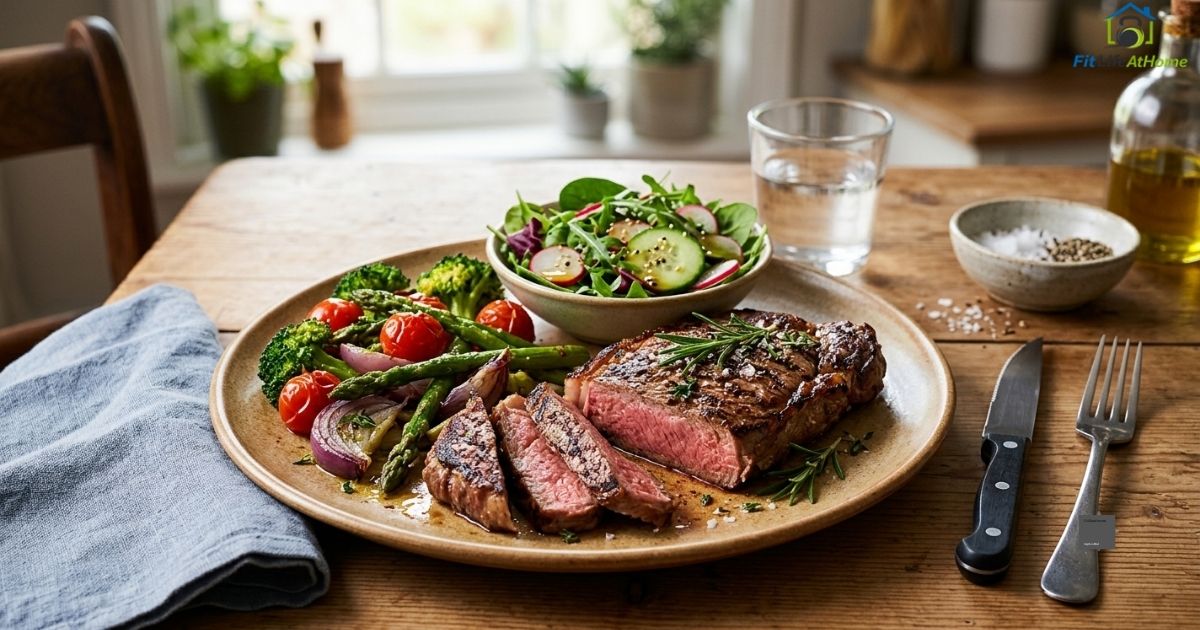
Can you eat steak and still lose weight?
Yes, you can eat steak and still lose weight, as long as it fits inside a calorie deficit. Nothing in a steak blocks fat loss. A calorie deficit simply means you are eating fewer calories than your body burns over time. That is the engine of weight loss, and every food either fits inside it or does not. Here is how steak fits:- It counts as calories, not as a moral choice. Steak is not “cheating.” It is protein and fat with a calorie cost you can plan around.
- It fits best as a planned protein, not the centerpiece of a binge. Build your day around your calorie and protein targets, then slot steak in.
- The cut and portion decide the calorie cost. A 5 oz top sirloin and a 16 oz ribeye are not remotely the same decision, even though both are “steak.”
What is actually in steak, and why it matters for fat loss
Steak earns its reputation because it is genuinely nutrient-dense. A 3.5 oz (100 g) cooked portion of a lean cut like eye of round gives you roughly:- 170 calories
- 28 g of complete protein (all nine essential amino acids)
- About 4 g of total fat, of which only around 1.5 g is saturated
- 0 g carbohydrate and 0 g fiber
- Highly bioavailable heme iron, plus zinc, selenium, vitamin B12, and niacin
- “Complete protein” means it contains every amino acid your body cannot make on its own.
- “Bioavailable” means your body absorbs it easily. The heme iron in beef is absorbed far better than the non-heme iron in plants, which is a real edge if your energy is low while dieting.
Why protein keeps you full
Protein is the most filling of the three macronutrients, which is the single biggest reason steak helps with weight loss. When you are fuller, you eat less without white-knuckling it. Here is what the research and practice point to:- Higher-protein diets, generally in the range of 1.2 to 1.6 g of protein per kilogram of body weight per day, tend to support fat loss while protecting muscle.
- Aiming for roughly 25 to 30 g of protein in a meal is a practical target for appetite control and muscle maintenance.
- Protein also nudges your natural “I am satisfied” hormones, including GLP-1 and PYY, the same satiety signals that the newer weight-loss medications work on.
Protein and protecting your muscle while you diet
When you lose weight, you can lose fat and muscle at the same time, and losing muscle is something you want to avoid. Adequate protein is your main defense.- Muscle is metabolically active, so keeping it helps support your resting metabolism.
- Protein plus resistance training is the proven combination for losing fat while keeping the muscle underneath.
- The classic mistake: crash dieting on very low protein. You lose weight on the scale, but a chunk of it is muscle, and your metabolism pays for it later.
Does steak’s “thermic effect” really burn fat?
You may have read that protein burns calories just to digest it. That is true, but let me be honest about the size of the effect so you do not over-rely on it.- Protein does have a higher “thermic effect of food,” meaning your body spends more energy digesting it than it does on carbs or fat.
- That effect is real but modest. It is a small tailwind, not a fat-burning hack.
- The far bigger levers are your total calories and your total protein. Treat the thermic effect as a nice bonus and nothing more.
“Allowed” versus “optimal”: is steak the best protein for fat loss?
Here is the distinction almost every article skips, and it is the most useful thing in this guide. The question “is steak good for weight loss” is secretly two questions:- Can I eat steak and still lose weight? Yes, easily, inside a deficit.
- Is steak the most efficient fat-loss protein available? Not always.
- Satiety. The bit of fat in steak keeps many people fuller and more satisfied than plain chicken breast.
- Micronutrient density. Steak brings more heme iron, zinc, B12, and creatine than poultry.
- Adherence. The best protein is the one you will actually eat all week without quitting your plan.
- Chasing the leanest possible macros and you do not mind repetitive meals? Lean poultry or fish may serve you better.
- Struggling with hunger, boredom, or staying consistent? Steak earns its place on your plate.
Which steak cut should you choose?
The cut is the single biggest lever you control after portion size, so this is where to spend your attention at the meat counter. Below I have ranked common cuts by the metric that actually matters for fat loss, which is protein per calorie, not just total fat.The leanest cuts, ranked by protein per calorie
Most guides rank steak by fat grams. I prefer ranking by protein per 100 calories, because that is the number that tells you how much muscle-supporting protein you are buying for each calorie you spend.| Cut (3 oz cooked, trimmed) | Calories | Protein | Total fat | Protein per 100 cal |
| Eye of round | ~150 | 25 g | 4 g | ~17 g |
| Top round | ~155 | 25 g | 4 g | ~16 g |
| Top sirloin | ~160 | 25 g | 6 g | ~16 g |
| Bottom round | ~160 | 24 g | 5 g | ~15 g |
| Sirloin tip | ~160 | 24 g | 5 g | ~15 g |
| Flank | ~160 | 24 g | 7 g | ~15 g |
| Tenderloin (filet) | ~180 | 23 g | 8 g | ~13 g |
| New York strip | ~185 | 23 g | 9 g | ~12 g |
| T-bone | ~210 | 21 g | 14 g | ~10 g |
| Porterhouse | ~220 | 20 g | 15 g | ~9 g |
| Ribeye | ~290 | 21 g | 22 g | ~7 g |
- The “round” cuts win on efficiency. Eye of round and top round give you the most protein per calorie, though they are also the least tender.
- Top sirloin is the sweet spot. It is nearly as lean, far more enjoyable to eat, and runs roughly 60 percent or more of its calories from protein.
- Ribeye is the opposite end. It carries the most fat and the lowest protein per calorie, which is exactly why it tastes so good. Marbling is flavor.
How to read cuts, grades, and labels
You do not need to memorize the table. You need two shortcuts and one definition.- Look for “loin” or “round” in the name. Those words usually signal a leaner cut.
- Mind the grade. USDA grades run Select, then Choice, then Prime, in order of increasing marbling and fat. Select is leanest, Prime is fattiest.
- Know the USDA “lean” definition. To be labeled lean, a serving must have under 10 g total fat, under 4.5 g saturated fat, and 95 mg or less of cholesterol. Cuts like top sirloin and tenderloin qualify.
Grass-fed versus grain-fed: does it matter for weight loss?
Short answer, not much for weight loss specifically. Here is the honest breakdown:- Protein is essentially identical. A 3 oz serving of grass-fed sirloin has about the same protein as grain-fed.
- Grass-fed is slightly leaner and has a different fat profile, with more omega-3s and CLA.
- The cut and the portion matter far more than the feed type. Do not overpay for grass-fed expecting a fat-loss shortcut. Buy it if you prefer the taste or the fat profile, not because it will move the scale.
Why the leanest cut is not always the best cut
This is the trade-off nobody tells you. Always choosing the leanest cut strips out the very fat that keeps you full and satisfied, which can quietly hurt your adherence. So flip the logic:- First, hit your total protein target for the day.
- Then choose your cut based on the situation:
- Pick the leanest cut when you want maximum protein per calorie.
- Pick a slightly fattier cut when satisfaction and sticking to the plan matter more.
How to keep a fattier cut you love
You do not have to give up ribeye to lose weight. You have to do the math instead of banning it.- Shrink the portion. A 5 oz ribeye is a very different calorie cost than a 12 oz one.
- Lower the frequency. Make it a once-a-week thing rather than a nightly habit.
- Trim the visible fat before or after cooking.
- Bank calories elsewhere that day, for example a lighter, leaner lunch.
How much steak, and how often?
For most people losing weight, a portion of about 3 to 6 oz of cooked steak per meal is the sweet spot. The trick is knowing what that looks like in the real world, because portion distortion is where most diets quietly fail.What a weight-loss portion really looks like
You do not need a food scale forever, but you do need to calibrate your eye. Use these visual anchors for cooked steak:- The palm of your hand (no fingers) is roughly 5 oz.
- A deck of cards is roughly 3 oz.
- Weigh your steak a handful of times at home so you learn what 5 oz looks like.
- At restaurants, order by the ounce and notice the thickness.
- Box half of an oversized cut before you start eating, not after.
- Remember that the bread, sauces, and sides usually add more calories than the steak itself.
How often per week?
There is no magic number, but here is sensible guidance grounded in public health recommendations:- General dietary guidance puts most people around the equivalent of a few servings of red meat across a week, not daily steak dinners.
- The UK’s NHS suggests that if you currently eat a lot of red and processed meat, cutting down toward about 70 g per day is reasonable.
- Rotate your proteins. Mixing in fish, poultry, eggs, and plants gives you a broader nutrient base and keeps meals interesting.
How to log steak accurately: raw versus cooked weight
This is the most underrated tracking trap I see, and fixing it can change your numbers more than any cut swap. Meat loses roughly 25 percent of its weight when cooked, because it loses water and some fat. So a 6 oz raw steak becomes only about 4.5 oz once cooked. That means if you log the wrong state, your calories can be off by about a quarter. Here is the fix:- Pick one state and match your data to it. If your tracker entry says “raw,” weigh the steak raw. If it says “cooked,” weigh it cooked.
- Do not mix the two. Logging a cooked weight against a raw database entry, or the reverse, is exactly where the math falls apart.
- The protein does not change. Cooking removes water, not amino acids, so the total protein stays the same whether you weigh raw or cooked.
Does the saturated fat in steak matter for weight loss?
Here is where almost every article muddles two completely different questions. Let me separate them cleanly, because the answer is genuinely reassuring for weight loss and more nuanced for long-term health. Saturated fat is the type of fat that is solid at room temperature and that health bodies suggest limiting for heart health. Now the two questions:- Will steak’s saturated fat stop you losing weight? No. If your steak fits your calorie deficit, the saturated fat does not block fat loss. Weight loss runs on calories, not on whether the fat is saturated.
- Should you think about saturated fat at all? Yes, but as a separate, longer-term heart-health question, not a weight-loss one.
- The mainstream caution. The American Heart Association recommends keeping saturated fat to a small share of daily calories, often cited as around 5 to 6 percent for people who would benefit from lowering cholesterol. Observational studies also link very high red-meat intake with higher cardiovascular and colon-cancer risk.
- The emerging nuance. Clinical trials on unprocessed red meat, meaning actual steak rather than bacon or deli meat, at moderate intake have generally not shown clear weight gain or a consistent cardiovascular effect. The strongest disease associations tend to track processed meat, not a sensible portion of steak.
How to cook steak, and build the plate, for weight loss
How you cook the steak and what you put next to it can swing the calories of a meal dramatically. The steak is rarely the problem. The butter bath and the fries usually are.Cooking methods that do not add calories
- Choose dry, high-heat methods: grill, broil, or pan-sear. These shed surface fat rather than soaking it in.
- Skip the butter finish and the breading. Brush a measured bit of oil on the meat instead of pouring it in the pan.
- Trim visible fat before cooking to drop calories without touching protein.
- Marinate lean cuts with an acid like vinegar or citrus plus a little oil. This adds tenderness, not many calories.
- Rest then slice thin across the grain. Thin slices feel more satisfying, which helps a smaller portion go further.
- Cook to a safe temperature. The USDA recommends a safe minimum internal temperature of 145 F for whole cuts, followed by a 3-minute rest.
What to eat with steak: best and worst sides for weight loss
Steak has zero fiber, so the side dish does the heavy lifting for fullness and volume. Choose sides that add bulk and fiber for few calories, and treat the calorie-dense ones as occasional rather than default.| Best sides (high volume, high fiber, lower calorie) | Calorie-dense sides (treat as occasional) |
| Broccoli, roasted or steamed | Mashed potatoes with butter and cream |
| Asparagus | French fries |
| A large mixed salad | Mac and cheese |
| Sauteed greens like spinach or kale | Creamed spinach |
| Roasted peppers, zucchini, or mushrooms | Onion rings |
Steak versus other proteins: when steak wins
So how does steak actually stack up against the usual alternatives? Here is a quick, honest comparison per 3 oz cooked serving, with a “pick this when” note so you can decide on the fly.| Protein (3 oz cooked) | Calories | Protein | Fat | Standout | Pick this when |
| Top sirloin steak | ~160 | 25 g | 6 g | Iron, zinc, B12, creatine | You want satiety plus micronutrients |
| Chicken breast | ~140 | 26 g | 3 g | Best protein per calorie | You want the leanest macros |
| Salmon | ~175 | 19 g | 10 g | Omega-3 fats | You want heart-healthy fats |
| 90/10 ground beef | ~185 | 22 g | 10 g | Convenient and cheap | You want easy, flexible meals |
- For pure protein per calorie, chicken breast leads and lean steak is close behind.
- For micronutrient density, especially iron and B12, steak has the edge.
- For omega-3s, salmon wins outright.
- For sticking to your plan, the best protein is the one you will eat consistently.
Steak weight-loss myths, debunked
A lot of steak advice is folklore. Here are the myths I hear most, with the quick facts that replace them.| Myth | Fact |
| “Red meat makes you gain weight.” | Calories decide weight, not the food category. Steak fits inside a deficit. |
| “You can only eat the leanest cuts.” | Any cut fits with the right portion and frequency. Lean is a tool, not a rule. |
| “Steak causes belly fat.” | No food spot-adds or spot-reduces belly fat. Overall calorie balance drives fat loss. |
| “Never eat steak at night.” | Meal timing does not change your daily calorie math. Eat it when it fits your day. |
| “Protein’s thermic effect torches fat.” | It is real but modest. Total calories and total protein matter far more. |
Who should be more cautious with steak
For most healthy people, lean steak in sensible portions is a smart choice. Some groups should be a bit more careful, and this is where a quick chat with a professional pays off. Be more mindful of cut and frequency, and lean toward the leanest cuts in smaller portions, if you:- Have high cholesterol or existing heart disease
- Have high blood pressure or type 2 diabetes
- Have a strong family history of cardiovascular disease
- Are pregnant, in which case steak should be cooked thoroughly
The verdict: how to make steak work for fat loss
So, is steak good for weight loss? Yes, with eyes open. Steak is not the single most protein-efficient food on the planet, but it more than earns its place because of its satiety, its nutrient density, and the simple fact that people actually enjoy eating it and stick with it. If you remember nothing else, remember the formula: Calorie deficit + right cut + right portion + balanced plate. Do those four things and steak is one of the most enjoyable foods you can build a fat-loss plan around.For the most protein per calorie, the “round” cuts like eye of round and top round lead. For the best balance of leanness and taste, top sirloin is hard to beat.
Chicken breast has a slight edge on protein per calorie, while steak offers more iron, zinc, and B12, and often more satiety. The better choice is the one you will eat consistently.
No food makes you gain weight on its own. Weight gain comes from a sustained calorie surplus. Steak in a portion that fits your calorie target does not cause weight gain.
Ribeye is higher in fat and calories, but it is not off-limits. Use a smaller portion, eat it less often, trim the fat, and balance your calories elsewhere that day.
There is no fixed rule, but rotating steak with fish, poultry, and plant proteins gives you a better nutrient mix. If you eat a lot of red and processed meat, cutting toward about 70 g per day is a reasonable target.
No food targets belly fat specifically. What works is an overall calorie deficit plus enough protein to keep your muscle, and steak’s protein helps on the second point.
Only marginally. Grass-fed is slightly leaner with a different fat profile, but the protein is about the same. Your cut and portion matter far more than the feed type.
Either works, as long as you match your tracking data to it. Weigh raw and use raw nutrition data, or weigh cooked and use cooked data. Just do not mix them, since cooked meat weighs roughly 25 percent less.
Yes. Meal timing does not change your total daily calories, which is what drives weight loss. Eat steak whenever it fits your day, including dinner.