
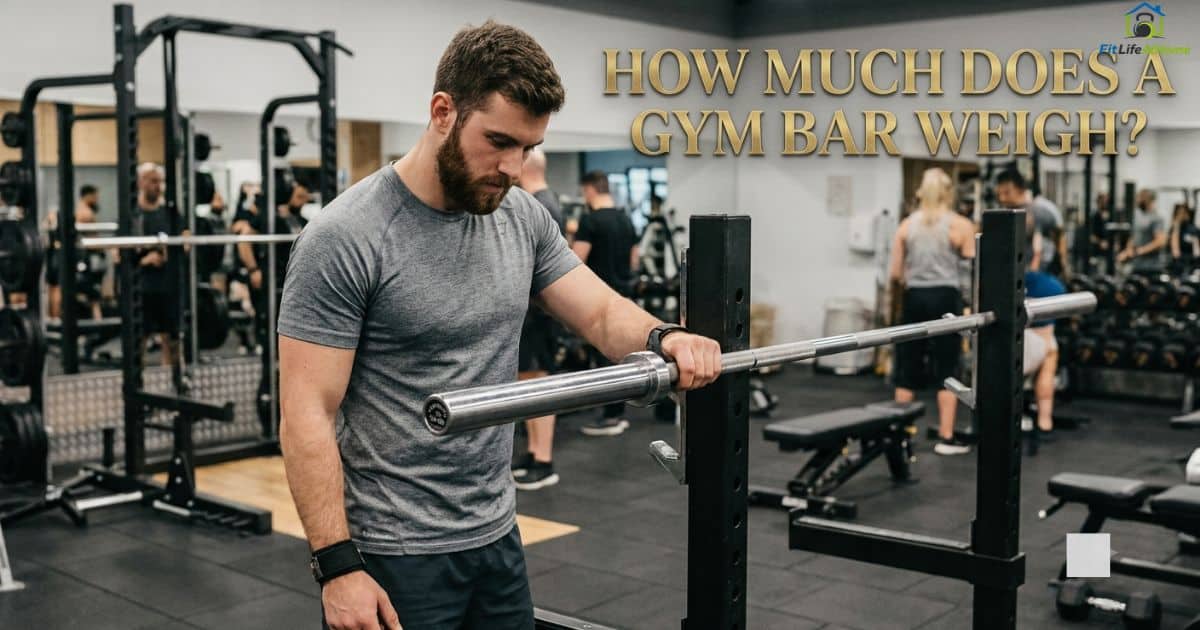
The standard gym bar, the long barbell you see on bench press and squat racks, weighs 45 pounds (20 kilograms). But not every bar in the gym weighs 45 pounds. Women’s Olympic bars weigh 33 pounds, EZ curl bars weigh 15 to 25 pounds, trap bars weigh 45 to 60 pounds, and Smith machine bars can weigh anywhere from 6 to 45 pounds depending on the machine. Knowing exactly which bar you are lifting is the difference between accurate progress tracking and guessing.
This guide covers the real weight of every bar you will find in a commercial or home gym, how to identify each one in seconds, and why getting this number right matters more than most lifters realize.

Key Takeaways
- The standard men’s Olympic barbell weighs 45 lb (20 kg). This is the bar on almost every bench press, squat rack, and deadlift platform in American gyms.
- Not all bars are 45 lb. Women’s bars, curl bars, technique bars, trap bars, and specialty bars all weigh different amounts.
- Smith machine bars are the least predictable. Counterbalancing means the same movement can feel 20 to 40 pounds lighter than a free weight barbell.
- Always count the bar in your total. If you squat 45 lb plates on each side of a 45 lb bar, you are squatting 135 lb, not 90 lb.
- When in doubt, ask staff or check the bar’s end cap. Many gyms label bar weights on the sleeve or end cap.
Complete Gym Bar Weight Chart
Here is every common gym bar, its typical weight, and where you will usually find it.
Bar Type | Weight (lb) | Weight (kg) | Length | Common Use |
Men’s Olympic barbell | 45 lb | 20 kg | 7.2 ft (2.2 m) | Squat, bench, deadlift, rows |
Women’s Olympic barbell | 33 lb | 15 kg | 6.6 ft (2.01 m) | Same lifts, thinner grip |
Power bar (powerlifting) | 45 lb | 20 kg | 7.2 ft | Heavy squat, bench, deadlift |
Squat bar (specialty) | 55 lb | 25 kg | 7.9 ft | Heavy squats |
Deadlift bar | 45 lb | 20 kg | 7.5 ft | Deadlifts (more whip) |
Technique/training bar | 5 to 15 lb | 2.5 to 7 kg | 5.5 to 6 ft | Learning form |
EZ curl bar (Olympic) | 15 to 25 lb | 7 to 11 kg | 4 ft | Curls, triceps work |
EZ curl bar (standard) | 10 to 15 lb | 4.5 to 7 kg | 4 ft | Home gym arm work |
Trap bar (hex bar) | 45 to 60 lb | 20 to 27 kg | Varies | Deadlifts, shrugs, carries |
Safety squat bar | 60 to 70 lb | 27 to 32 kg | 7 to 7.5 ft | Squats with shoulder issues |
Standard 1-inch bar | 12 to 20 lb | 5 to 9 kg | 5 to 7 ft | Budget home gyms |
Smith machine bar | 6 to 45 lb | 3 to 20 kg | Fixed in machine | Guided pressing and squats |
Fixed-weight barbell | 20 to 110 lb | 9 to 50 kg | ~4 ft | Marked on the bar itself |
Weights outside of competition bars vary by manufacturer. When a range is listed, check the specific bar at your gym.
The Standard Gym Bar: 45 Pounds (20 kg)
The bar on nearly every bench press station, squat rack, and deadlift platform in a US gym weighs 45 pounds, which is 20 kilograms. This is the men’s Olympic barbell, and it is the default bar in commercial gyms. If someone says “the bar” with no other detail, they mean this one.
Useful details:
- It is technically 44.1 lb. The international standard is exactly 20 kg, which converts to 44.09 lb. US gyms round this to 45 lb, and American-made bars are often built to a true 45 lb spec. For tracking, use 45 lb.
- It is 7.2 feet (2.2 meters) long.
- The shaft is about 28 to 29 mm thick. This is the fastest way to tell a men’s bar from a women’s bar.
- The sleeves are 2 inches (50 mm) in diameter. Olympic plates with 2-inch holes fit this bar. Standard plates with 1-inch holes do not.
The International Weightlifting Federation (IWF) sets the 20 kg spec for men’s competition bars, and the International Powerlifting Federation (IPF) uses the same standard. Commercial gym bars follow the convention even without certification.
Is the bench press bar the same as the squat bar?
In almost every commercial gym, yes. The bench press bar and the squat rack bar are the same 45 lb Olympic barbell. Gyms buy one general-purpose bar and use it everywhere. The exceptions are dedicated powerlifting gyms, which stock specialty squat and deadlift bars.
Women's Olympic Bar: 33 Pounds (15 kg)
The women’s Olympic barbell weighs 33 pounds (15 kg), is 6.6 feet long, and has a thinner 25 mm shaft. It is the competition standard for women’s Olympic weightlifting, and many commercial gyms keep a few on the floor.
The thinner shaft is the giveaway. If a bar feels noticeably easier to wrap your hand around, you are probably holding a 15 kg bar. It also has no center knurling and is about 7 inches shorter than the men’s bar.
The women’s bar is not a “beginner bar.” It is a full competition implement built to hold hundreds of pounds. Use whichever bar fits your hands and your program, and log the correct weight.
EZ Curl Bar: 15 to 25 Pounds
A typical Olympic EZ curl bar weighs 15 to 25 pounds, with most commercial gym versions landing around 18 to 22 pounds. Standard 1-inch EZ curl bars sold for home gyms are lighter, usually 10 to 15 pounds.
The EZ curl bar is the short zigzag bar used for biceps curls, skull crushers, and upright rows. The angled grip reduces wrist strain compared to a straight bar.
Here is the problem: EZ curl bars are almost never labeled, and the weight varies between brands more than any other free weight bar. Ask the front desk, check the manufacturer’s website, or weigh it yourself. If you cannot verify it, log it as 20 lb and stay consistent so your tracking still works.
Trap Bar (Hex Bar): 45 to 60 Pounds
Most trap bars weigh between 45 and 60 pounds, but there is no universal standard. Common models cluster at 45 lb, 55 lb, and 60 lb, and some heavy-duty open trap bars weigh 65 to 70 lb.
The trap bar is the hexagonal frame you stand inside for deadlifts, shrugs, and carries. Because you cannot compare it to a straight bar by feel, it is the bar people most often log incorrectly.
Two quick ways to find your trap bar’s weight:
- Check the frame or end caps. Many manufacturers stamp the weight on the bar.
- Search the exact model. If your gym stocks a known brand, the spec sheet is one search away.
If neither works, ask staff. A 15 lb error on a deadlift is a meaningful chunk of your total.
Safety Squat Bar: 60 to 70 Pounds
Safety squat bars typically weigh 60 to 70 pounds (about 27 to 32 kg), noticeably heavier than a standard barbell. The padded yoke, forward-angled handles, and camber all add steel.
This bar lets you squat without pulling your shoulders into an awkward position, which makes it popular with lifters who have shoulder or elbow issues. The camber shifts the load forward, so a safety bar squat feels harder than a back squat at the same weight. Do not expect numbers to transfer one-to-one, and always log which bar you used.
Deadlift Bars, Power Bars, and Squat Bars
Specialty powerlifting bars mostly stay at 20 kg (45 lb), with one exception: dedicated squat bars often weigh 25 kg (55 lb). The differences between these bars are more about length, stiffness, and shaft diameter than weight.
- Power bar: 45 lb. Stiffer, more aggressive knurling, 29 mm shaft. Built for heavy squat, bench, and deadlift.
- Deadlift bar: 45 lb. Longer (about 7.5 ft) and thinner (27 mm shaft), designed to flex or “whip” so the plates leave the floor slightly later. Same weight, different feel.
- Squat bar: 55 lb. Longer, thicker (32 mm), and stiffer to stay stable under very heavy loads. This is the one specialty straight bar that breaks the 45 lb rule.
Unless you train at a powerlifting gym, you may never touch these. If you visit one, ask which bars they stock before assuming every straight bar is 45 lb.
Technique Bars: 5 to 15 Pounds
Technique bars weigh 5 to 15 pounds and exist for one purpose: learning barbell movements before the 45 lb bar is manageable. They are usually aluminum or hollow steel, shorter than a full bar, and often found near the group fitness area or coaching zones.
There is zero shame in starting here. Squatting a 15 lb technique bar with good form builds better habits than grinding ugly reps under a bar you are not ready for. Move up to the 33 lb or 45 lb bar when the movement feels solid.
Smith Machine Bars: The 6 to 45 Pound Wild Card
A Smith machine bar can weigh anywhere from 6 to 45 pounds, and there is no way to know without checking, because most Smith machines use a counterbalance that offsets part of the bar’s real weight. The bar itself might be 30 to 45 lb of steel, but internal pulleys and counterweights can cut the effective starting weight to 15, 20, or 25 lb. Some machines are counterbalanced to nearly zero.
This is the most common source of inaccurate gym logging:
- Your Smith machine bench is not your barbell bench. The machine fixes the bar path, removes stabilizer demand, and starts you at a lighter effective weight. A 135 lb Smith press and a 135 lb barbell press are different lifts.
- Two Smith machines rarely match. Even within the same gym chain, different machine models can have different starting resistances.
How to find your Smith machine’s bar weight:
- Look for a sticker or plate on the frame. Many manufacturers list the starting resistance.
- Ask the staff. Gyms often know or can look up the model spec.
- Test it. Hang a luggage scale from the resting bar.
- If all else fails, log it as a machine. Track “Smith machine bench: bar + 90 lb” instead of converting to a fake barbell number.
The rule: never compare Smith machine numbers to free weight numbers, and never expect them to line up mid-program.
Standard Bars vs Olympic Bars: The Home Gym Trap
Standard bars have 1-inch ends, weigh 12 to 20 pounds, and are common in budget home gym sets. Olympic bars have 2-inch rotating sleeves and weigh 45 pounds. If you bought a barbell set from a big-box store for under $150, you probably own a standard bar, not a 45 lb Olympic bar.
Feature | Olympic Bar | Standard Bar |
Bar weight | 45 lb (20 kg) | 12 to 20 lb |
Sleeve diameter | 2 in (50 mm) | 1 in (25 mm) |
Sleeves rotate | Yes | No |
Plate compatibility | Olympic plates only | Standard plates only |
Typical load capacity | 700 to 1,500+ lb | 200 to 300 lb |
Where found | Commercial gyms, serious home gyms | Budget home sets |
Home gym owners who assume their standard bar weighs 45 lb overstate every lift by 25 to 30 pounds. And if you train at home on a standard bar, remember the commercial gym bar is 25+ pounds heavier before loading your usual plates.
How to Identify a Gym Bar in Under 10 Seconds
Check three things: length, sleeve size, and grip thickness. A 7-foot bar with fat 2-inch rotating sleeves is the 45 lb Olympic bar. Anything shorter, thinner, or shaped differently is not.
The checklist:
- Is it over 7 feet long with 2-inch sleeves? It is almost certainly 45 lb.
- Is it about 6.5 feet with a noticeably thinner grip and no center knurling? Women’s bar, 33 lb.
- Is it short and zigzag shaped? EZ curl bar, 15 to 25 lb.
- Is it a hexagon you stand inside? Trap bar, 45 to 60 lb. Check the frame for a stamp.
- Does it have a padded yoke and forward handles? Safety squat bar, 60 to 70 lb.
- Is it attached to a machine on rails? Smith machine. Check the frame sticker or ask.
- Is it short with weight numbers printed on it? Fixed barbell. The number on it is the total weight.
- Are the ends only about 1 inch thick? Standard bar, 12 to 20 lb.
When nothing on this list settles it, the end cap often will. Many manufacturers print the weight, brand, and model on the cap at the end of the sleeve.
Should You Count the Bar Weight? Yes, Always
Always include the bar in your lifted total. The bar is weight, your muscles are moving it, and every standard strength program, calculator, and competition counts it. An empty 45 lb bar bench press is a 45 lb bench press, not zero.
The math: bar weight plus all plates. A 45 lb bar with a 45 lb plate per side is 135 lb. Add a 25 to each side and you are at 185 lb.
Skipping the bar creates two problems. Your log understates your strength, so program percentages go wrong: if a plan calls for 80% of a max that is missing 45 lb, every working set is miscalculated. And you lose comparability, because strength standards, 1RM calculators, and every other lifter’s numbers all include the bar.
Why Bar Weight Mistakes Quietly Break Progressive Overload
Progressive overload only works when the numbers are real. If you switch bars without noticing, your log can show progress that did not happen, or hide progress that did. This is the practical reason bar identification matters, and it is the part most articles skip.
Three real-world examples:
- The trap bar switch. You deadlift 245 lb on a straight bar, then move to a trap bar you assume is 45 lb but is actually 60 lb. You load the same plates and log 245, but you lifted 260. Your log now understates your pull.
- The Smith machine “PR.” You bench 155 lb on free weights, then hit 185 on a counterbalanced Smith machine and log a 30 lb PR. Back on the barbell, 185 buries you. Nothing regressed; the numbers were never comparable.
- The traveling lifter. Your home gym has a 33 lb women’s bar. The hotel gym has a 45 lb bar. Load your usual plates on the road and every set is 12 lb heavier than planned.
The fix takes five seconds: identify the bar, log the bar, and note the bar type on any unusual lift. “Deadlift 260 (trap bar)” is a record. “Deadlift 245” on a bar you never identified is a guess.
Commercial Gym vs Home Gym: What to Expect
Commercial gyms standardize on 45 lb Olympic bars almost everywhere, while home gyms are a mix of Olympic, standard, and budget bars where nothing should be assumed.
Situation | What the bar probably weighs |
Big-chain commercial gym, bench or rack | 45 lb |
Commercial gym, shorter thin-grip bar | 33 lb |
Commercial gym curl station | 15 to 25 lb (verify) |
Commercial gym Smith machine | 6 to 45 lb effective (verify) |
Home gym with 2-inch plates | 45 lb Olympic bar (usually) |
Home gym with 1-inch plates | 12 to 20 lb standard bar |
Budget “barbell + plates” boxed set | Standard bar, count the box specs |
If you own your bar, settle it once: check the manufacturer spec or weigh it, write the number down, and never wonder again.
Bar Weight Cheat Sheet
Save this list. It covers 95% of what you will ever touch:
- The big bar on racks and benches: 45 lb
- Shorter, thinner bar: 33 lb
- Zigzag curl bar: about 20 lb
- Hex frame you stand in: 45 to 60 lb, check the stamp
- Padded yoke squat bar: 60 to 70 lb
- Smith machine: check the sticker, often 15 to 25 lb
- Skinny bar with 1-inch ends: 12 to 20 lb
- Short bar with a number on it: the number is the weight
Common Bar Weight Mistakes to Avoid
The most common errors: assuming every bar is 45 lb, comparing Smith machine numbers to free weights, and never verifying home gym equipment.
- Assuming all straight bars are 45 lb. Women’s, technique, and standard bars all look like “a barbell” from across the room.
- Treating Smith machine weight as barbell weight. Different starting resistance, different lift.
- Never checking the trap bar. The widest weight range of any common bar, and rarely labeled clearly.
- Forgetting the bar entirely. Logging only plate weight understates every lift by 33 to 45 lb.
- Ignoring bar changes when switching gyms. New gym, new bars. Spend two minutes identifying them on day one.
- Estimating curl bar weight differently every session. Pick a number and stay consistent.
Expert Tips for Tracking Bar Weight Accurately
Verify once, log consistently, and note the bar type whenever you use anything other than the standard 45 lb bar. Habits that make this automatic:
- Read end caps. Brand, model, and often the weight are printed right there.
- Ask staff on day one at a new gym. “What do your Smith machines and trap bars weigh?” takes ten seconds.
- Weigh your own equipment. A bathroom scale settles any home gym question permanently.
- Add bar notes to your log. “SSB squat 185” and “squat 185” should never share a line in your training history.
- When you cannot verify, be consistent. A curl bar logged as 20 lb every week still shows true progress even if the real number is 18.
Frequently Asked Questions
The standard Olympic barbell weighs 45 lb (20 kg) empty. That is your starting load before any plates go on, and it counts toward your total.
No. Only the full-size men’s Olympic bar is 45 lb. Women’s bars are 33 lb, curl bars run 15 to 25 lb, trap bars run 45 to 60 lb, safety squat bars run 60 to 70 lb, and technique bars can be as light as 5 lb.
In nearly every commercial gym, the bench press bar is a standard 45 lb (20 kg) Olympic barbell. Gyms rarely stock a separate bench-specific bar.
Anywhere from about 6 to 45 lb, depending on the machine’s counterbalance system. Check the sticker on the frame or ask staff, because the number varies by model and cannot be judged by feel.
The international standard is exactly 20 kg, which is 44.1 lb. US gyms round to 45 lb, and many American-made bars are manufactured to a true 45 lb spec. Use 45 lb for tracking in the United States.
No. The 15 kg bar is a full competition barbell with a thinner 25 mm grip. Anyone can train with it. Just log 33 lb instead of 45 lb.
Measure the ends. Olympic sleeves are 2 inches thick and rotate; standard bar ends are 1 inch and fixed. Olympic bars weigh 45 lb, standard bars usually 12 to 20 lb.
Fixed barbells, the short pre-loaded bars on a rack, have their total weight printed on them, typically in 10 lb jumps from 20 to 110 lb. The printed number is the entire weight.
A real workout. Pressing or squatting the empty bar is lifting 45 lb, and it is exactly where most beginners should start while learning form.
Quality Olympic bars are rated between 700 and 1,500+ lb depending on the steel. Standard 1-inch bars are usually rated around 200 to 300 lb, which is a real safety limit, not a suggestion.
Not usually. The 29 mm power bar and 28 mm Olympic bar both weigh 20 kg; thickness mainly changes grip feel. The exception is the 32 mm squat bar at 55 lb.
Yes, and if 45 lb is too heavy, start with a 33 lb women’s bar, a 15 lb technique bar, or dumbbells. Building the movement pattern first makes every future pound safer.
Stand on a bathroom scale holding the bar vertically, then subtract your body weight. Short bars can go directly on the scale. Either way you are within a pound, which is plenty for logging.
The Bottom Line
The standard gym bar weighs 45 pounds, and for most lifts in most American gyms, that is the number to log. But the floor is full of exceptions: 33 lb women’s bars, 20 lb curl bars, 60 lb trap bars, 70 lb safety squat bars, and Smith machines that could be almost anything. Ten seconds of identification, checking length, sleeves, grip, and end cap, protects months of training data.
Count the bar, know the bar, and your progressive overload numbers will always mean what you think they mean.
This article is for general fitness information. If you are new to strength training, consider a session with a qualified trainer to learn barbell movements safely. 0