
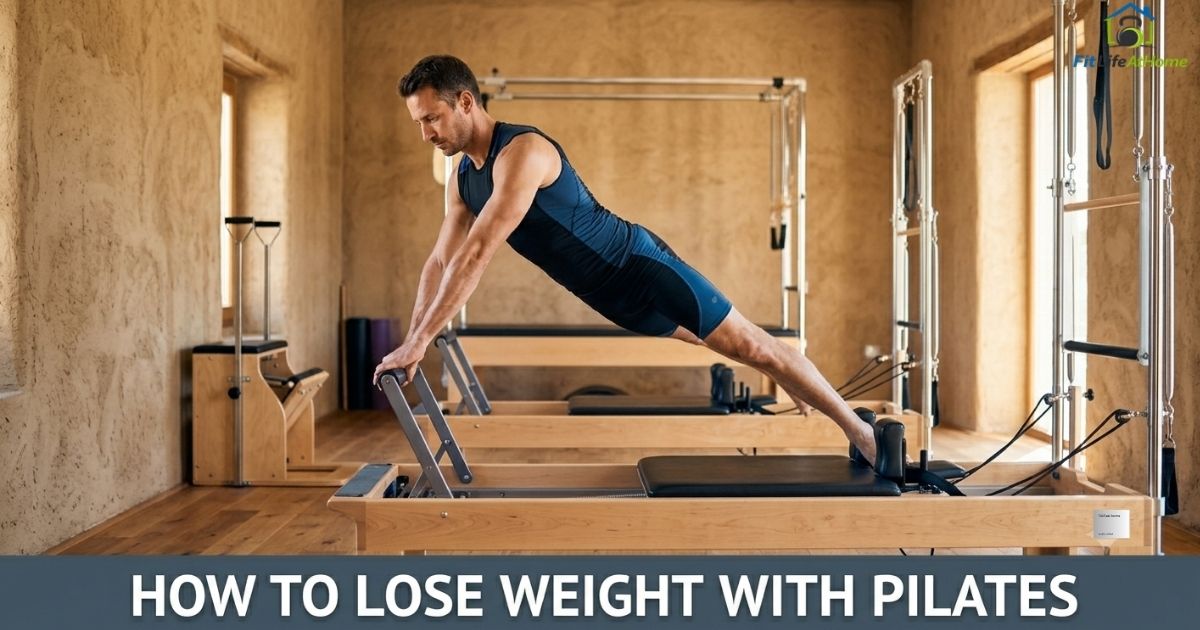
Yes, Pilates can help you lose weight just not the way most people assume. Pilates on its own won’t melt fat. Weight loss happens when you burn slightly more calories than you eat, and no single workout overrides that math. What Pilates does brilliantly is build lean muscle, strengthen your core, and stay gentle enough on your joints that you’ll actually keep showing up. Pair it with a moderate calorie deficit and a little cardio, and it becomes a genuinely effective part of a fat-loss plan.
Here’s what this guide covers:
- A 4-week plan that actually progresses week to week not the same routine four times
- The key moves, with easier and harder versions
- How to eat for fat loss without crash dieting
- How to track progress when the scale won’t move
- The common mistakes that quietly stall results
Can You Actually Lose Weight With Pilates? The Honest Answer
Here’s the truth I wish more fitness articles led with: the calorie deficit does the heavy lifting, and Pilates supports it.
What the research shows:
- A 2017 study published in the Archives of Physical Medicine and Rehabilitation found that eight weeks of Pilates helped 37 women with overweight lose weight, shrink their waists, and improve body composition.
- Broader reviews of controlled trials report the same direction of lower body weight, BMI, and body-fat percentage in people carrying excess weight.
- The catch: Pilates is a modest calorie burner. Estimates put a 50-minute mat session at roughly 175 calories, with reformer work closer to 254 less than a hard run.
So why make it your foundation?
- It builds lean muscle, which nudges up the calories you burn at rest.
- It strengthens the core that powers every other workout.
- It’s low-impact, so you can keep doing it for years.
In my experience, the people who lose weight and keep it off aren’t doing the “hardest” workout they’re doing one they don’t dread. That’s Pilates’ real edge: adherence.
Pilates | Higher-intensity cardio | |
Calories per session | Lower–moderate | Higher |
Builds core & lean muscle | Yes | Less so |
Joint impact | Low | Higher |
Easy to stick with | High | Varies |
Best role | The foundation you keep | The calorie booster |
What to Realistically Expect in 4 Weeks
Four weeks is enough to feel real change, but not always to see it on the scale. As exercise physiologist Heather Milton of NYU Langone told TODAY, early strength gains over the first four to six weeks come mostly from your nervous system getting more efficient, while visible changes in muscle size take closer to 12 weeks.
Within four weeks, most beginners can expect to:
- Move with noticeably better core control and posture
- Lose a few inches before the scale shifts much
- Feel more energetic day to day
- Lock in a consistent workout habit
Week | What you’ll likely notice |
1 | Moves feel awkward; growing body awareness; maybe mild soreness |
2 | Form clicks; sessions feel smoother; core engages more easily |
3 | Noticeably stronger; longer holds; clothes may fit differently |
4 | Clear strength gains vs. week 1; better posture; habit locked in |
If the scale barely moves after four weeks, that’s normal, not failure. You’ve built the muscle and the habit that drives fat loss over the months ahead.
Before You Start: Mat, Reformer, Home, or Studio?
You need very little to begin.
- Essential: a mat, comfortable clothes, a bit of floor space.
- Nice to have (for later): a resistance band, a Pilates ring, light dumbbells.
The big beginner question is mat versus reformer:
Factor | Mat Pilates | Reformer Pilates |
Cost | Free–low | Higher (studio or machine) |
Where | Anywhere, at home | Studio, or own a machine |
Resistance | Bodyweight (+ bands) | Adjustable springs |
Best for | Starting now on a budget | Variety and challenge later |
My honest take: most beginners don’t need a reformer to lose weight. Here’s a simple way to decide:
- Want to start today for free → mat at home.
- Want feedback and motivation, and have the budget → a studio class.
- Somewhere in between → a structured app or video.
How to Eat for Fat Loss (Without Crash Dieting)
You can’t out-Pilates a poor diet, so this section matters as much as the workouts. Setting up your nutrition takes four steps:
- Find your maintenance calories using a free TDEE calculator.
- Subtract a moderate 300–500 calories per day. Don’t cut more aggressive crash diets backfire, especially alongside a low-burn workout, because you lose muscle along with fat.
- Prioritize protein. Sports-nutrition research generally points to around 1.6 — 2.2 grams per kilogram of bodyweight to protect muscle. No-math version: a palm-sized portion at every meal.
- Build a balanced plate: ½ non-starchy vegetables, ¼ lean protein, ¼ smart carbs, plus a thumb of healthy fat.
A few quiet multipliers most people ignore:
- Good sleep
- Daily steps and everyday movement (NEAT)
- Portion awareness, instead of obsessive calorie counting
How Much Cardio Do You Actually Need?
Cardio isn’t mandatory, but it adds the calorie burn Pilates is lighter on and it speeds things up. You don’t need to punish yourself for it.
Zone 2 (easy) | Intervals / HIIT | |
Intensity | Conversational — pass the “talk test” | Hard bursts + recovery |
Examples | Brisk walk, easy cycle | Hill repeats; 30s hard / 90s easy |
Calorie burn | Steady, moderate | High, in less time |
When | Weeks 1–4, your workhorse | Add from week 3 |
How to fit it in:
- Weeks 1–2: two easy Zone 2 sessions a week.
- Weeks 3–4: keep one Zone 2 session and add one short interval session.
- Weekly target: roughly 150 minutes of moderate activity, in line with CDC guidance — which this plan already covers.
One simple rule: if you can’t talk in short sentences while you go, you’re working too hard for Zone 2, so ease off.
The 4-Week Pilates Plan
Here’s what separates this plan from the “just do this one routine” advice everywhere else: it progresses. Week 1 builds form, week 2 adds volume, week 3 adds intensity, and week 4 peaks. Each week you’ll add reps, slow the tempo, or add resistance.
The plan uses four kinds of days:
- Strength days — total-body work for core endurance and glutes.
- Control days — slower sessions for spinal mobility and breathing.
- Active recovery — light stretching that helps you bounce back (not the same as a rest day).
- Rest — full recovery so your muscles can adapt.
Week 1 — Foundation & Form
Day | Activity | Focus / Duration |
1 | Pilates: Foundation | Learn form & breathing — 30 min |
2 | Cardio: Zone 2 | Easy walk — 25 min |
3 | Active recovery | Mobility/stretch — 15 min |
4 | Pilates: Foundation | Neutral spine — 30 min |
5 | Cardio: Zone 2 | Easy walk — 25 min |
6 | Pilates: Core & glutes | Total-body basics — 30 min |
7 | Rest | Full rest or a gentle walk |
Week 2 — Building Endurance
Day | Activity | Focus / Duration |
1 | Pilates: Strength + band | Add a resistance band — 35 min |
2 | Cardio: Zone 2 | 35 min |
3 | Active recovery | Mobility — 15 min |
4 | Pilates: Control & breathing | Spinal control — 35 min |
5 | Cardio: Zone 2 | 35 min |
6 | Pilates: Strength + band | Endurance focus — 35 min |
7 | Rest | Full rest |
Week 3 — Adding Intensity
Day | Activity | Focus / Duration |
1 | Pilates: Strength + ring/weights | Slow tempo, more resistance — 40 min |
2 | Cardio: Zone 2 | 35 min |
3 | Pilates: Control & core | Longer holds — 40 min |
4 | Cardio: Intervals | Bursts + recovery — 20 min |
5 | Pilates: Strength + ring/weights | 40 min |
6 | Active recovery | Mobility — 15 min |
7 | Rest | Full rest |
Week 4 — Peak & Reassess
Day | Activity | Focus / Duration |
1 | Pilates: Strength + full resistance | Peak volume — 45 min |
2 | Cardio: Intervals | Higher intensity — 20–25 min |
3 | Pilates: Control & mobility | Quality movement — 40 min |
4 | Cardio: Zone 2 | 40 min |
5 | Pilates: Strength + full resistance | 45 min |
6 | Pilates: Total-body + benchmark | Re-test your plank hold & Hundred reps — 40 min |
7 | Rest | Plan your next block |
A few rules for progressing safely:
- Only add load when your form holds and the current week feels controlled.
- If a week feels like too much, repeat it before moving on.
- It’s not a race — consistency beats intensity every time.
Progression at a glance:
Week | Pilates days | Resistance | Cardio | Focus |
1 | 3 | Bodyweight | 2× Zone 2 | Form & habit |
2 | 3 | + Band | 2× Zone 2 | Endurance |
3 | 3 | + Ring/weights | Zone 2 + intervals | Intensity |
4 | 4 | Full resistance | Intervals + Zone 2 | Peak & reassess |
The Key Moves (With Easier and Harder Versions)
These six moves form the backbone of your sessions. The golden rule: if you feel a move mostly in your neck or lower back, that’s a cue to reset your form, not a sign you need a harder version.
- The Hundred. On your back, legs in tabletop, curl your head and shoulders up and pump straight arms in small beats in for 5, out for 5, to 100. Don’t yank the neck; keep it relaxed.
- Easier: feet down, head resting, 50 beats.
- Harder: extend the legs to 45°.
- Bridge. Feet flat, press through your heels and lift your hips into a straight line, squeezing your glutes at the top. Don’t overarch the lower back.
- Easier: a smaller range.
- Harder: single leg, or a band around the thighs.
- Single-Leg Stretch. Curl up, pull one knee in while the other leg extends, then switch with control. Don’t let your lower back pop off the mat.
- Easier: keep the extended leg higher.
- Harder: lower it toward the floor.
- Plank. Hold a straight line from heels to head on forearms or hands, bracing your core. Don’t let your hips sag or pick up.
- Easier: drop to your knees.
- Harder: add slow shoulder taps.
- Roll-Up. Lie flat, arms overhead, then peel your spine off the mat one vertebra at a time toward your toes and roll back down slowly. Control beats momentum.
- Easier: bend your knees.
- Harder: slow it down even more.
- Side-Lying Leg Series. On your side, hips stacked: open the top knee like a clam, then straighten the legs and lift the top one with control great for the glutes.
- Easier: a smaller range.
- Harder: a band above the knees.
How to Track Progress (When the Scale Won't Move)
This is the make-or-break habit. Early on, the scale lies: water shifts and new muscle can mask fat loss, so your weight might stall or even tick up while your body is genuinely changing.
Track these instead:
- Waist and hip measurements — a better fat-loss signal than weight alone.
- Progress photos and how your clothes fit.
- Strength benchmarks — your plank hold and Hundred reps in week 4 versus week 1.
Date | Weight | Waist | Photo? | Plank hold | Notes |
Week 1 | |||||
Week 4 |
A couple of measuring rules that keep you sane:
- Weigh once a week, same morning, same conditions.
- Skip daily weigh-ins — they mostly track water and will mess with your head.
Make the Plan Fit Your Life
Real life isn’t a perfect schedule. Adjust without guilt:
If you’re… | Adjust by… |
Short on time (~20 min) | 3 key moves + a 10-min walk; consistency over length |
A total beginner | Start at the easier versions; repeat a week if needed |
Stuck at a desk all day | Lean into control/posture days + walking breaks |
Training at home, no gear | Mat-only path; bands optional |
Plateaued | Recheck your deficit; add resistance or tempo |
Common Mistakes That Stall Weight Loss
The mistakes I see most often have little to do with the workout itself:
- Relying on Pilates alone with no calorie deficit. Pair it with diet and a little cardio.
- Crash dieting, which burns muscle. Keep the deficit moderate and protein high.
- Never progressing — same routine, same body. Add reps, tempo, or resistance.
- Sloppy form, which is both less effective and riskier. Use the easier versions until you’re solid.
- Quitting when the scale stalls, before recomposition shows up. Track strength and inches.
- “Earning” treats — undoing a 200-calorie session with a 500-calorie snack.
Myths About Pilates and Weight Loss
Myth | Reality |
Pilates spot-reduces belly fat | You can’t target fat loss; it strengthens the core, and fat drops overall in a deficit |
Pilates alone melts fat | It supports fat loss; a calorie deficit drives it |
You need a reformer | A mat and bodyweight are enough to start |
Pilates is “just stretching” | It’s real strength and core-endurance work |
More soreness = better results | Soreness means novelty, not progress |
What to Do After Week 4
Finished the month? Don’t stop — build on it:
- Recalculate your deficit. Re-run a calorie calculator with your current weight.
- Start your next block around week 3 intensity, since you’ve already adapted.
- Add one new challenge: a harder variation, a reformer class, or longer intervals.
- Keep tracking strength so you know you’re still moving forward.
One thing worth repeating: as you lose weight, your maintenance calories drop, so recalculate every few weeks. An old deficit can quietly turn into maintenance without you noticing.
Frequently Asked Questions
Three to four sessions a week, alongside some cardio and a moderate calorie deficit. Consistency across the month matters more than any single session.
Not by targeting it — spot reduction isn’t real. Pilates tones the deep core, and belly fat shrinks as your overall body fat drops.
Strength and posture often improve within a few weeks; visible body changes usually take 8–12 weeks of consistency.
Both are light calorie burners; Pilates leans more toward core strength. The better one is whichever you’ll actually stick with.
Yes — if you stay consistent, keep some intensity, and hold a calorie deficit. Short and regular beats long and sporadic.
No, but it adds calorie burn and speeds results. Even daily walking counts.
Either works. A reformer adds adjustable resistance, but a mat is plenty to start and far cheaper.
Light sessions most days are fine, but keep at least one rest day so your muscles can adapt.
No — it builds lean, long muscular endurance, not bulk.
Final Thoughts
Pilates won’t melt fat by itself, but as the foundation of a smart plan it absolutely works — and because it’s sustainable, it’s the kind of plan you’ll still be following next month. Stick to the formula:
- A moderate calorie deficit
- 3–4 Pilates sessions a week
- A bit of cardio
- Steady weekly progression
Trust the strength gains and the way your clothes fit more than the number on the scale. Roll out your mat and start week 1 today — future you will be glad you did.
This article is for general information and isn’t medical advice. Check with a doctor before starting a new exercise or diet plan, especially if you have any health conditions.