

yes, you can eat rice and still lose weight. Weight loss comes down to eating fewer calories than you burn, not cutting one single food. Rice fits a fat-loss plan as long as you follow four simple rules:
- Watch the portion — about half a cup to one cup cooked.
- Pick a higher-fiber type when you can.
- Fill half your plate with vegetables.
- Add a lean protein to every rice meal.
Do those four things, and rice belongs on your plate, guilt-free. The rest of this guide shows you exactly how, what is a myth, and a few honest caveats most articles skip.
In my experience, rice is rarely the reason the scale won’t budge the second helping and the oily curry on top usually are. I still eat it most days and have no plans to stop. Keep the bowl small, pair it with some protein, and rice earns its place on your plate.
Why Rice Got a Bad Name (and Why It's Wrong)
Rice became a diet villain for three reasons:
- It is a refined carb, which low-carb culture taught us to fear.
- It raises blood sugar faster than some other foods.
- It is a “white food,” lumped in with sugar and white bread.
None of that means rice makes you fat. Here is what the research actually shows:
- Observational studies lean positive. A large study of U.S. adults found that people with higher whole-grain intake had lower odds of both general and belly obesity.
- Controlled trials are more modest. A 2020 review found whole grains produced only a slight drop in body weight, and a later review found no significant effect on body fat at all.
The takeaway is simple: rice is not a weight-loss drug, and it is not a weight-gain trap either. Your total calories decide the outcome.
One last myth to clear up. You have probably heard rice has a “high glycemic index.” That is true, but the glycemic index ignores how much you eat. Glycemic load accounts for the portion, which is why a small bowl of white rice barely moves the needle for most people. Portion beats type, almost every time.
The Rice Weight-Loss Playbook
1. Get Your Portion and Type Right
Watch the portion first. This is where most rice calories hide.
- A serving is half a cup to one cup cooked (about 75 to 150 grams).
- One cup of cooked white rice holds around 205 calories.
- The first serving is rarely the problem. The second and third helpings — plus the oil, ghee, and sauces — are what add up.
- No scale handy? A cupped handful is a close-enough portion.
Pick a higher-fiber type when you can. Brown, black, red, and wild rice keep you full longer. But know the trade-off:
- The myth: brown rice is far lower in calories. The truth: the gap is only about 10 to 20 calories per cup.
- Brown’s real edge: more fiber and nutrients, plus a steadier blood sugar response.
- White rice still wins on: easier digestion, added iron in many countries, and lower arsenic.
If you love white rice, you do not have to quit it.
The cooling trick, told straight. Cooling cooked rice turns some starch into resistant starch, which your body treats more like fiber than sugar. Here is the method:
- Cook your rice as usual.
- Chill it in the fridge for a few hours.
- Reheat it before eating — the benefit stays.
What to expect, honestly:
- Resistant starch carries about 2.5 calories per gram versus 4 for regular starch.
- Cooling can more than double the resistant starch in rice.
- The real calorie saving is only about 10 to 15 percent — not the “half the calories” you see in viral headlines.
It is a small bonus, not a magic hack.
2. Match the Rice to Your Goal
There is no single “best” rice. The right one depends on you:
- Worried about blood sugar? Parboiled or brown basmati (lower glycemic response).
- Sensitive stomach or IBS? Plain white rice (gentler, less fiber to irritate).
- Active or building muscle? Wild rice (more protein) or white rice as fast post-workout fuel.
- Want to feel full the longest? Black, red, or wild rice (most fiber).
- Cutting calories hard? Blend in cauliflower rice for volume with very few calories.
3. Build a Better Plate
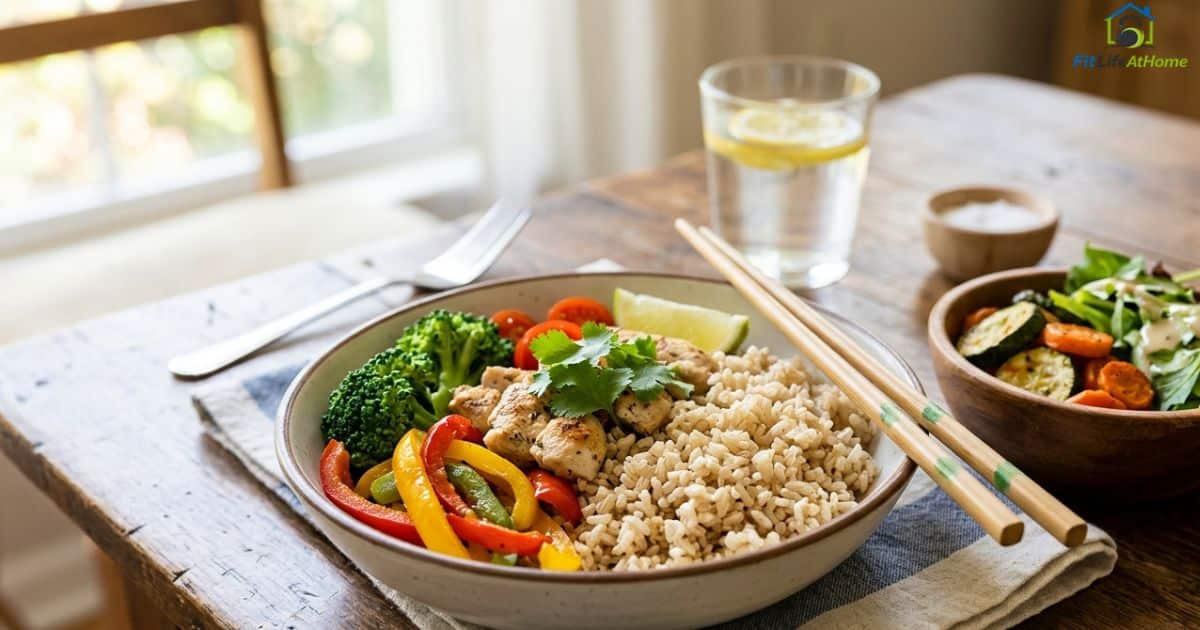
How you fill the plate matters more than the rice itself. Use this split:
- ½ plate vegetables — broccoli, greens, peppers, whatever you enjoy.
- ¼ plate lean protein — chicken, fish, eggs, tofu, or beans.
- ¼ plate rice.
Protein and fiber slow digestion and soften the blood sugar spike, so you stay full longer on fewer calories. A few plates that work well:
- Basmati + grilled chicken + roasted broccoli.
- Brown rice + baked salmon + a big salad.
- A veggie-and-tofu stir-fry over a small scoop of rice.
Want to stretch it further? Mix your rice half and half with cauliflower rice or chopped broccoli — same full bowl, far fewer calories.
4. Does Timing Matter?
A little, but less than people claim. Here is what genuinely helps:
- Eat rice earlier in the day so you have more active hours to use the energy.
- Have rice after a workout — it refills your muscles’ fuel stores.
- Keep dinner lighter if heavy carbs at night affect your sleep or digestion.
And here is what to ignore:
- “Rice at night makes you fat” is mostly a myth. Total daily calories drive fat loss, not the clock.
Eat your rice at the time that helps you stick to your plan.
5. Smart Swaps Without Giving Up Rice
You do not have to replace rice to upgrade it:
- Quinoa blend — two-thirds rice, one-third quinoa for more protein and fiber with the same texture.
- Cauliflower rice — the biggest calorie cut, as a full or partial swap.
- Other grains — barley and bulgur add fiber and variety. Rotate them in now and then.
6. Eating Rice on Ozempic or Wegovy
With GLP-1 medications everywhere now, this question comes up a lot. Two things to keep in mind:
- Smaller portions happen on their own — these drugs curb your appetite, so you naturally eat less.
- Still pair rice with protein — this steadies your blood sugar and helps protect muscle while you lose weight.
Rice stays on the plate. You just keep the portion small and the protein high.
7. One Safety Step Most Guides Skip: Arsenic
Rice naturally absorbs arsenic from soil, and brown rice holds a little more than white. This is not a reason to panic, but one simple habit helps. Cook your rice like pasta:
- Use six to ten parts water to one part rice.
- Boil until tender.
- Drain the excess water.
The payoff, per the FDA:
- This removes 40 to 60 percent of the inorganic arsenic.
- For brown rice, it cuts arsenic by about half while losing only a small amount of iron.
- Rinsing alone does little — and rotating in other grains helps too.
Myth vs. Fact
- “Rice causes belly fat.” False — a calorie surplus causes fat gain, from any food.
- “You must switch to brown rice.” False — brown has more fiber, but the calories are nearly identical.
- “Rice at night makes you gain weight.” False for most people — total calories matter, not timing.
- “Rice is worse than bread or pasta.” False — they are all starchy carbs with similar calories per serving.
- “Skipping rice is the fastest way to lose weight.” Misleading — cutting any food can lower calories, but you do not need to cut rice to do it.
Frequently Asked Questions
About half a cup to one cup cooked per meal works for most people, as long as your total daily calories support fat loss. Pair it with protein and vegetables to stay full.
No. White rice is fine in a controlled portion. It is lower in fiber than brown, so adding protein and vegetables helps keep you full.
All rice is similar, around 200 to 240 calories per cooked cup. To cut calories, blend in cauliflower rice or use a smaller scoop.
Yes. Daily rice is fine if your portions and total calories are in check. Billions of people eat rice every day; the amount is what matters.
Neither is clearly better. Both are carb sources with similar calories. Choose the one that fits your meal and keep the portion controlled.
Slightly. Cooling rice forms resistant starch and can trim roughly 10 to 15 percent of the calories. It is a small help, not a major one.
The Bottom Line
Rice is not the reason the scale will not move. Portion size, what sits on the rest of your plate, and your total calories are. Your simple checklist:
- Keep the serving small — half a cup to one cup cooked.
- Pile on the vegetables — half your plate.
- Add a protein to every rice meal.
- Pick the rice type that suits your body and goal.
Do those four things, and you can enjoy rice for life and still reach your goals.