
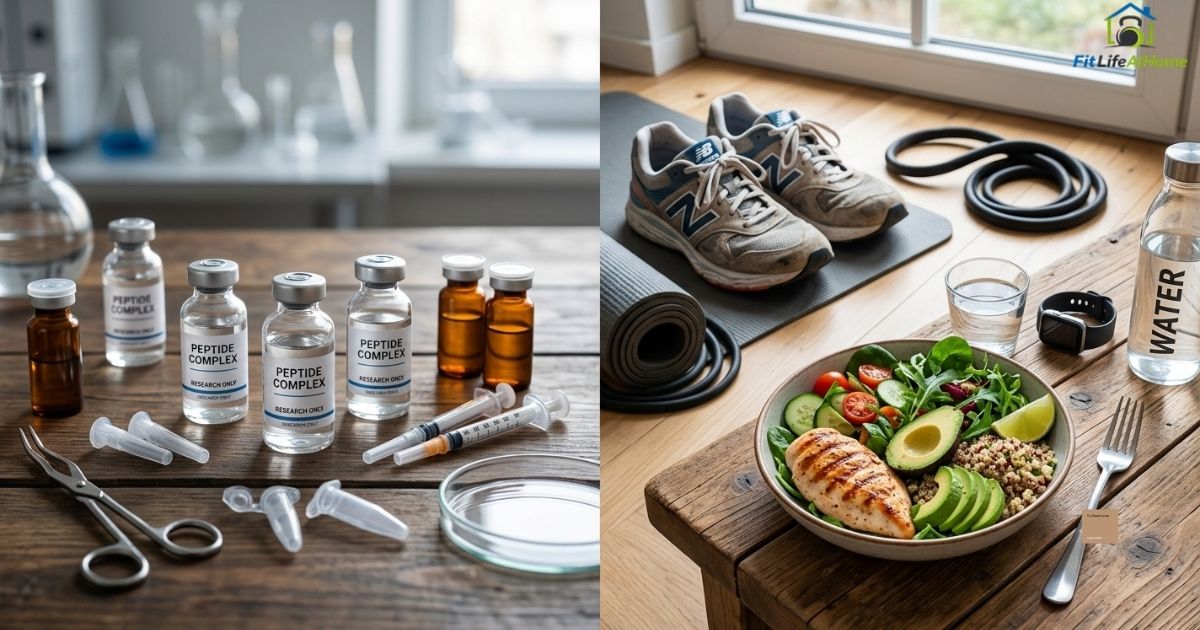
Do You Actually Need Peptides to Lose Fat?
No — you don’t need peptides to lose fat, and for most people asking the question, the honest answer is “not yet.” Peptides like semaglutide (Wegovy) and tirzepatide (Zepbound) are tools that work through a calorie deficit and training, not instead of them. The benefits people credit to peptides — preserving muscle, boosting metabolism, speeding recovery — are mostly things your own protein intake and resistance training provide, or claims that aren’t well supported in the first place. The bottom line in one sentence: Peptides can make a calorie deficit easier to sustain — but diet and training are what actually decide whether you lose fat and keep muscle. Here’s the fastest way to know where you stand:- If you haven’t yet sustained a real calorie deficit, 2–4 strength sessions a week, and adequate protein for 8–12 straight weeks → start there. That’s the foundation, and it’s free.
- If you have done all that, you’ve stalled, and you meet a genuine medical threshold → then a peptide is a conversation worth having with a qualified clinician.
What Are “Weight-Loss Peptides,” Really? (Two Very Different Things)
Before comparing anything, you need to know that “weight-loss peptides” is not one thing — it’s two completely different categories that marketing deliberately blends together. Peptides are simply short chains of amino acids that act as signaling molecules in the body. But the gap between the two types you’ll see advertised is enormous. The two categories:- FDA-approved prescription GLP-1 / GIP drugs. These are the real, clinically proven ones:
- Semaglutide (Wegovy)
- Tirzepatide (Zepbound)
- Liraglutide (Saxenda)
- They work mainly by reducing appetite and slowing how fast your stomach empties, so you naturally eat less. They require a prescription, and they have large clinical trials behind them.
- Unapproved “research” peptides. These are the ones sold in a legal gray area and marketed hardest on social media:
- AOD-9604, CJC-1295, ipamorelin, tesamorelin, and similar compounds
- They’re advertised for “fat burning,” “metabolism,” and “recovery,” but the evidence is weak to non-existent, and none are FDA-approved for weight loss.
What Do Diet and Training Actually Do for Fat Loss? (And Why Nothing Replaces Them)
To understand why a peptide can’t replace the basics, you have to understand what the basics actually do. Fat loss comes down to a few mechanisms, and each one does a specific job that no injection can do for you. Get these right and you’ll lose fat with or without any medication; get them wrong and no peptide will save the result.The only non-negotiable: a calorie deficit
A calorie deficit — burning more energy than you eat — is the one thing fat loss cannot happen without. This is the rule peptides don’t break; they simply make it easier to follow.- What it does: decides whether you lose weight at all.
- How peptides relate: GLP-1 drugs don’t bypass the deficit — they help you hit it by turning down hunger so you eat less without a daily fight.
- What this means for you: if your nutrition isn’t in a deficit, adding a peptide just makes you a person with suppressed appetite who still isn’t losing fat efficiently.
Protein: the muscle-protecting nutrient
Protein is the single most important nutrient when you’re losing weight, because it’s what allows your body to hold onto muscle while shedding fat.- Target range: roughly 1.6–2.2 grams per kilogram of body weight per day for active people in a deficit.
- Why it matters most in a deficit: when energy is scarce, the body will break down muscle for fuel unless protein and training signal it not to.
- The catch on peptides: appetite suppression can make it shockingly easy to under-eat protein — which is exactly how people end up “skinny-fat.”
Resistance training: the muscle-preserving engine
Lifting weights is not optional if you care about what you lose, not just how much. Resistance training is the signal that tells your body to keep its muscle while the deficit strips away fat.- Frequency: 2–4 strength sessions per week is plenty for most people.
- The key principle: progressive overload — gradually doing a little more over time — is what preserves and builds muscle.
- The honest truth: this, not any drug, is the single biggest factor deciding whether your weight loss is mostly fat or partly muscle.
The underrated multipliers: sleep, steps, and NEAT
These are cheap, powerful, and almost universally ignored.- Sleep: poor sleep raises hunger and undercuts recovery.
- Steps / NEAT (the calories you burn just moving around): an easy, sustainable way to widen your deficit without formal cardio.
What Do Diet and Training Actually Do for Fat Loss? (And Why Nothing Replaces Them)
To understand why a peptide can’t replace the basics, you have to understand what the basics actually do. Fat loss comes down to a few mechanisms, and each one does a specific job that no injection can do for you. Get these right and you’ll lose fat with or without any medication; get them wrong and no peptide will save the result.The only non-negotiable: a calorie deficit
A calorie deficit — burning more energy than you eat — is the one thing fat loss cannot happen without. This is the rule peptides don’t break; they simply make it easier to follow.- What it does: decides whether you lose weight at all.
- How peptides relate: GLP-1 drugs don’t bypass the deficit — they help you hit it by turning down hunger so you eat less without a daily fight.
- What this means for you: if your nutrition isn’t in a deficit, adding a peptide just makes you a person with suppressed appetite who still isn’t losing fat efficiently.
Protein: the muscle-protecting nutrient
Protein is the single most important nutrient when you’re losing weight, because it’s what allows your body to hold onto muscle while shedding fat.- Target range: roughly 1.6–2.2 grams per kilogram of body weight per day for active people in a deficit.
- Why it matters most in a deficit: when energy is scarce, the body will break down muscle for fuel unless protein and training signal it not to.
- The catch on peptides: appetite suppression can make it shockingly easy to under-eat protein — which is exactly how people end up “skinny-fat.”
Resistance training: the muscle-preserving engine
Lifting weights is not optional if you care about what you lose, not just how much. Resistance training is the signal that tells your body to keep its muscle while the deficit strips away fat.- Frequency: 2–4 strength sessions per week is plenty for most people.
- The key principle: progressive overload — gradually doing a little more over time — is what preserves and builds muscle.
- The honest truth: this, not any drug, is the single biggest factor deciding whether your weight loss is mostly fat or partly muscle.
The underrated multipliers: sleep, steps, and NEAT
These are cheap, powerful, and almost universally ignored.- Sleep: poor sleep raises hunger and undercuts recovery.
- Steps / NEAT (the calories you burn just moving around): an easy, sustainable way to widen your deficit without formal cardio.
The 3 Things Marketing Credits to Peptides (And What’s Actually True)
Most of the hype around peptides rests on three specific claims: that they preserve muscle, that they boost your metabolism, and that they speed up recovery so you can train harder. These claims show up everywhere — clinic websites, social media, even AI search summaries. Here’s what the actual research says about each one.Myth 1: Do Peptides Preserve Muscle?
This is the claim that’s most often stated and most clearly backwards. The popular version says peptides make your body “shed fat instead of muscle.” The clinical data tells a more complicated — and more honest — story. Here’s what the landmark trials actually found about how much of the weight lost on a GLP-1 is lean mass (muscle and other non-fat tissue):- Semaglutide (STEP 1 trial): roughly 45% of total weight lost came from lean mass, per an analysis published in Circulation.
- Tirzepatide (SURMOUNT-1 trial): roughly 34% of total weight lost came from lean mass.
- Liraglutide: reported even higher in some analyses.
- “Lean mass loss” is not the same as “muscle wasting.” Fat is still the majority of what you lose, and the fat-to-muscle ratio usually improves.
- Some lean loss is normal and adaptive. A smaller body needs less tissue to support it.
- With proper support, muscle outcomes hold up. In the SEMALEAN study, lean mass dipped early but then stabilized, grip strength actually improved over 12 months, and the rate of sarcopenic obesity dropped.
- ❌ Myth: “Peptides preserve muscle.” → ✅ Fact: On their own, they lose a meaningful share of weight as lean mass. Training and protein preserve it.
- ❌ Myth: “Any lean-mass loss is dangerous wasting.” → ✅ Fact: Modest, adaptive lean-mass loss is different from pathologic wasting; managed well, your body composition still improves.
Myth 2: Do Peptides “Boost Your Metabolism” or “Burn Fat” Directly?
The second big claim is that peptides rev up your metabolism or actively “target” and burn fat. This one falls apart quickly when you look at how these compounds actually work.- GLP-1 drugs lose weight by reducing how much you eat — through appetite and fullness signals — not by speeding up your metabolic rate. In fact, like all weight loss, GLP-1 weight loss is accompanied by a modest drop in energy expenditure as you get smaller. That’s the opposite of a metabolism “boost.”
- The “fat-mobilizing” peptides failed their trials. The headliner here is AOD-9604, a growth-hormone fragment marketed to “mobilize stored fat” and “block new fat cells.” It showed a small short-term signal in an early study, but failed to produce meaningful weight loss in larger, longer human trials, and its development was discontinued. The marketing claim outlived the science.
- “Boosts your metabolism” is mostly ad copy. No weight-loss peptide reliably raises your metabolic rate enough to matter on its own.
- ❌ Myth: “Peptides rev your metabolism and burn fat for you.” → ✅ Fact: GLP-1s work through appetite, not metabolic rate, and the “fat-burning” research peptides like AOD-9604 failed their larger trials.
Myth 3: Do “Recovery” Peptides Help You Train Harder and Lose More Fat?
The third claim is that certain peptides trigger growth-hormone pulses that boost your energy and recovery, making it easier to train consistently. This is the most seductive claim for gym-goers — and the gap between what’s proven and what’s promised is the widest of all three. Here’s the honest picture:- The “raises growth hormone” part is real. Growth-hormone-secretagogue peptides like CJC-1295, ipamorelin, and sermorelin do reliably increase growth hormone and IGF-1 on a blood test (shown in research such as Teichman and colleagues in the Journal of Clinical Endocrinology and Metabolism, 2006).
- The “so you’ll recover better and lose more fat” part is not. Raising a hormone level on a lab report is not the same as a proven real-world benefit. Quality human trials showing meaningful improvements in recovery, energy, performance, or fat loss in healthy, trained people are lacking. Most of those benefit claims come from clinics that sell the peptides, and scientific reviews specifically point to the placebo effect and social-media amplification as major drivers of the hype.
- The downsides are real. These compounds are not FDA-approved for these uses, are banned in competitive sport, and — because they’re sold as research chemicals — carry genuine quality-control and counterfeit risks.
- ❌ Myth: “Recovery peptides make you train harder and lose more fat.” → ✅ Fact: They raise growth hormone on labs, but a real-world recovery or fat-loss benefit in healthy trainees isn’t established. Sleep, protein, and smart programming do that job.
So Should You Combine Peptides With Training? (The Realistic Synthesis)
To be fair, none of this means peptides are useless — it means they have a specific job. For the right person, combining a GLP-1 with serious training and high protein genuinely is the most effective and highest-quality approach to fat loss. The key is keeping the hierarchy straight. Here’s how the combination actually works when it works well:- The drug ends the white-knuckle hunger and makes the calorie deficit feel natural and sustainable.
- The training and protein protect your muscle and build the habits that keep the result after the drug is gone.
- The order of operations matters: training is the engine, the peptide is the optional turbocharger — never the other way around.
- ✅ Hit your protein target every day — even when you’re not hungry.
- ✅ Strength train 2–4 times per week, without exception.
- ✅ Don’t let your total intake crash just because your appetite did.
- ✅ Track your body composition and strength, not only the scale.
Do You Actually Need Them? (A Decision Framework)
This is the question almost no one selling peptides will answer honestly: maybe you don’t need them at all. The difference between someone who’s a genuine candidate and someone reaching for a shortcut comes down to a few honest checkpoints. You probably don’t need a peptide (yet) if:- You haven’t sustained a real deficit, regular strength training, and adequate protein for at least 8–12 weeks.
- You’re chasing the last 5–15 “vanity” pounds.
- Your sleep, daily movement, and stress are still unmanaged.
- You’re already at a healthy body-fat level.
- You meet a medical threshold (such as obesity, or being overweight with weight-related health conditions).
- You’ve genuinely built and sustained the foundation and still stalled.
- You have a metabolic condition where a qualified prescriber sees a clear benefit.
- Cosmetic “few pounds” use.
- Pregnancy or breastfeeding.
- Certain medical histories — which is exactly what a prescriber screens for.
- The lean lifter chasing the last 10 pounds who hasn’t dialed in protein → the answer is the foundation, not a drug.
- The person with obesity who’s sustained the basics for months and stalled → a legitimate conversation with a clinician.
- The person who lost weight fast on a cheap compounded peptide but skipped lifting → ended up softer, weaker, and regained it after stopping.
If You Decide to Try Them, How Do You Do It Safely?
If you’ve worked through the framework and a peptide makes sense for you, the single most important thing is to do it through legitimate medical channels. This matters more in 2026 than ever, because the rules around cheaper “compounded” versions have tightened significantly. The safe path, step by step:- Get evaluated by a licensed clinician who can confirm you’re a candidate.
- Fill a prescription at a legitimate, state-licensed pharmacy. These drugs are prescription-only for a reason.
- Ask your provider the right questions:
- Am I actually a candidate, and what are the risks for me?
- How will we monitor my muscle and nutrition?
- What’s the plan for eventually stopping?
- 🚩 No prescription required.
- 🚩 No licensed provider involved.
- 🚩 Prices that seem too good to be true.
- 🚩 Vague labeling, or products sold “for research use only.”
- 🚩 Sold as a powder you have to reconstitute (mix) yourself.
What Happens When You Stop? (The Exit Plan Nobody Mentions)
Here’s the part the marketing never plans for: what happens when the injections stop. This is the question that separates a temporary result from a permanent one, and it deserves an honest answer.- Appetite and weight often rebound after stopping a GLP-1 — if nothing else changed. The drug managed the symptom (hunger), not the underlying habits.
- The people who keep the results are the ones who used their time on the medication to build durable training and nutrition habits.
- The right mental model: a peptide is a bridge, not a destination.
Myth vs. Fact: Quick Reference
For a fast scan, here are the most common claims in this space and the honest verdict on each:| Claim | Verdict |
| “Peptides replace diet and exercise.” | ❌ Myth — they work through a deficit and training, not instead of them. |
| “Compounded peptides are the same as the brand, just cheaper.” | ❌ Myth — quality and safety vary, and the legal pathway is closing in 2026. |
| “You don’t need a prescription for weight-loss peptides.” | ❌ Myth — the legitimate ones are prescription-only. |
| “You’ll just regain all the weight anyway.” | ⚠️ Nuanced — only if you don’t build habits while on the drug. |
| “More weight loss is always better.” | ❌ Myth — the quality of the loss (fat vs. muscle) matters more than the number. |
Yes. The legitimate, clinically proven weight-loss peptides — semaglutide, tirzepatide, and liraglutide — are prescription-only medications. Any source offering them without a prescription or a licensed provider should be treated as a serious red flag, because it likely means an unapproved, compounded, or counterfeit product.
On their own, GLP-1s do lose a meaningful share of total weight as lean mass — roughly a third to nearly half in the landmark trials. But that isn’t the same as “muscle wasting,” and it’s largely preventable. Eating enough protein and doing resistance training is what protects your muscle while you lose fat, whether or not you’re using a peptide.
Absolutely — arguably more so. The appetite suppression that makes these drugs effective also makes it very easy to under-eat protein and lose muscle. Strength training and a solid protein intake are what ensure the weight you lose is mostly fat, so they become more important on a peptide, not less.
It depends on what that weight is made of. Faster scale loss isn’t automatically better if a large portion of it is muscle. The ideal for most people who qualify is the combination — but if you’re choosing, prioritize the approach that protects your muscle and that you can actually sustain.
For most people in that situation, yes. Prescription weight-loss peptides are designed and approved for clinically significant weight issues, not for trimming the last few pounds. If you have a relatively small amount to lose, dialing in your deficit, protein, training, and sleep will almost always get you there.
A consistent calorie deficit, adequate protein, two to four strength sessions a week, and decent sleep. It costs nothing, it’s the foundation every peptide still depends on, and it’s the approach that keeps working long after any medication stops.
The Bottom Line
Peptides don’t replace training and diet, and on their own they don’t preserve muscle, boost your metabolism, or reliably speed your recovery. What they do is make a calorie deficit easier to sustain for people who genuinely qualify. The foundation — a deficit, enough protein, resistance training, and good sleep — is what decides whether you lose fat and keep muscle, with or without a drug.
So the real answer to “do you actually need them?” is this:
- Build the foundation first. It’s free, it works, and every peptide depends on it anyway.
- If you’ve built it, stalled, and meet a medical threshold, talk to a qualified clinician about whether a peptide makes sense for you.
- If you do use one, treat it as a bridge — and keep training and eating protein as if you weren’t on it at all.
Medical disclaimer: This article is for general educational purposes only and is not medical advice. It does not provide dosing, sourcing, or treatment recommendations. Prescription weight-loss medications carry risks and are not appropriate for everyone. Always consult a qualified, licensed healthcare provider before starting, changing, or stopping any medication or supplement.