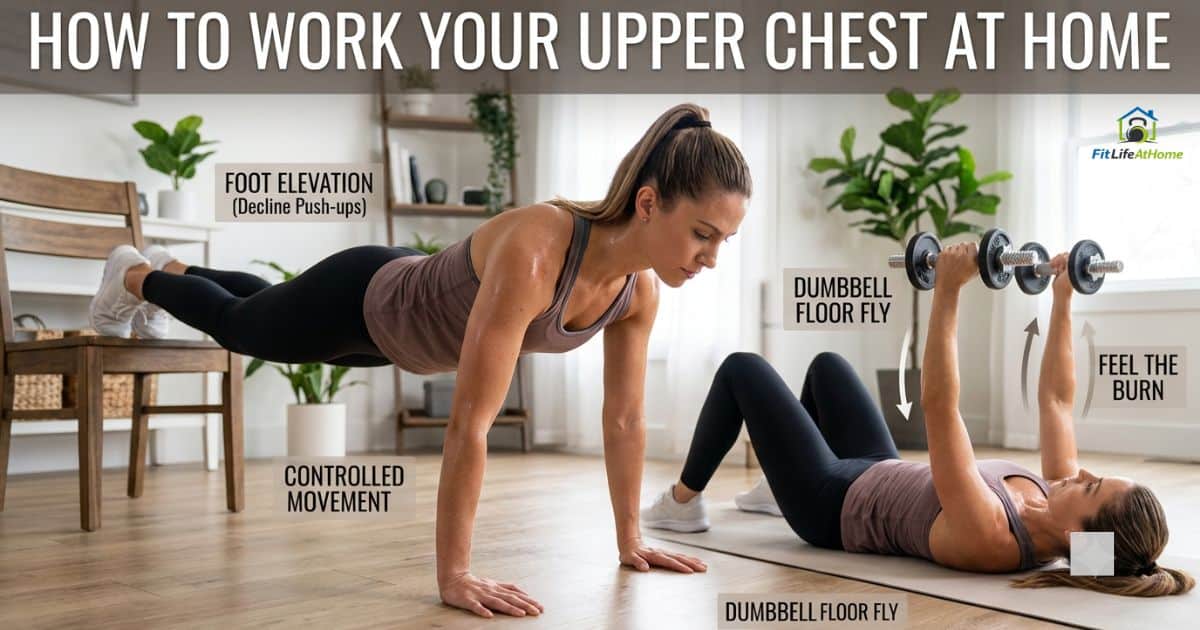
To work your upper chest at home without equipment, do feet-elevated push-ups. Putting your feet on a couch or chair tilts your body so you press upward, which shifts the load onto the upper part of your chest (the clavicular head). Do 3 to 4 sets of 8 to 15 reps, two or three times a week. Lower slowly, press your hands slightly toward each other at the top, and keep your shoulders pulled back. Once that feels easy, wear a backpack loaded with books.
Quick takeaways
- The upper chest grows when you press on an upward angle of about 30 degrees. Go past 45 degrees and your shoulders take over.
- Feet-elevated push-ups (often called decline push-ups) are the best no-gear move for the upper chest, even though the name sounds backward.
- Train the upper chest two or three times a week: 3 to 4 sets of 8 to 15 reps.
- No weights? Progress by slowing the reps, pausing at the bottom, and going deeper before you add load.
- Add real resistance at home with a loaded backpack or two water jugs.
Why the upper chest is the hardest part to build at home
Your upper chest lags because most home training hits the wrong angle. Here is what is going on:
- One muscle, two sections. The chest is a single muscle, the pectoralis major, with a lower and middle part and an upper part called the clavicular head.
- Flat moves miss the top. Standard push-ups and floor presses work the lower and middle chest, not the upper.
- The upper chest needs a slope. The clavicular head only fires hard when you press on an upward angle.
- The result. You end up looking flat or hollow right under the collarbone.
The fix is the angle, not gear.
The one rule that hits the upper chest
To target the upper chest, press on an upward angle of roughly 30 degrees. The evidence backs this up:
- The sweet spot is about 30 degrees. A study measuring muscle activity across five bench angles found that a 30-degree incline produced the most upper-chest activation (Rodríguez-Ridao et al., 2020).
- The ceiling is 45 degrees. Going steeper than that pushed the work onto the front of the shoulders and lowered performance.
- Copy it with no bench. Raise your feet so your body presses up and forward, and you recreate the same upward line with your own bodyweight.

Why a “decline” push-up works your upper chest
This part trips almost everyone up. Here is the logic in three steps:
- Lifting your feet tilts your body so you press upward.
- That upward press copies an incline press.
- So the word “decline” describes your body position, not the muscle it works.
Bottom line: for a bigger upper chest, elevate your feet, not your hands.
The best no-equipment upper chest exercises
Every move here needs nothing but the floor and a couch, chair, wall, or set of stairs. Work through them in order as you get stronger.
- Hands-elevated push-up (start here)
- How to do it: Put your hands on a couch or sturdy table and your feet on the floor.
- Why it works: It is the easiest version and leans on the mid chest, so it builds a base.
- Next step: Once you can do 15 clean reps, move to the feet-elevated version.
- Feet-elevated push-up (the main move)
- How to do it: Put your feet on a couch, chair, or step and your hands on the floor, a little wider than your shoulders.
- Form: Lower your chest with your elbows at about 45 degrees, press up, and squeeze your hands slightly inward. Keep your hips level and shoulders back.
- Make it harder: Raise your feet higher, or pause for 2 seconds at the bottom.
- Deficit push-up (deeper stretch)
- How to do it: Set your hands on two thick books so your chest can drop below them.
- Why it works: The extra range gives your upper chest a bigger stretch, which drives more growth.
- Make it harder: Add a pause at the bottom.
- Archer push-up (one side at a time)
- How to do it: From a wide stance, shift your weight over one arm as you lower, keeping the other arm straight.
- Why it works: It loads one side harder, so you get more resistance with no weights.
- Note: Alternate sides each rep.
- Lean-forward push-up (advanced)
- How to do it: Push your weight forward so your shoulders sit ahead of your wrists.
- Why it works: This tips the angle further up and makes your upper chest work harder to control the movement.
- Standing chest squeeze (anywhere)
- How to do it: Press your palms together in front of your upper chest and push hard for 5 to 10 seconds.
- Why it works: No floor work needed, so it is handy for a quick pump and for learning to feel your chest fire.
Add resistance without a gym
Once feet-elevated push-ups feel easy, you need more load, and you do not need dumbbells for that. Add weight with things you already own:
- Loaded backpack. Fill a backpack with books or water bottles and wear it during your push-ups. Add more over time.
- Water jugs. Hold or rest a couple of gallon jugs to add resistance to presses and squeezes.
- Couch and cushions. Stack firm cushions to build a roughly 30-degree slope, then press from that angle.
Small jumps in weight, done often, beat big random ones.
If you have bands or light dumbbells (optional)
Have a little gear? Add one of these to round things out:
- Resistance band. Anchor it low, pull the handles up and inward toward your upper chest in a sweeping arc, then lower slowly.
- Light dumbbells. Press them upward from a slight incline using a couch or cushions set to about 30 degrees.
Both are extras, not requirements.
How to program it: sets, reps, and how often
Set your training up like this:
- Frequency: two or three times a week.
- Sets and reps: 3 to 4 sets of 8 to 15 reps per move.
- Rest: 60 to 90 seconds between sets.
- Recovery: at least 48 hours between chest sessions.
The tricky part at home is getting harder without weights. Pull these levers in order:
- Add more reps.
- Slow the lowering to 3 or 4 seconds.
- Pause at the bottom of each rep.
- Go deeper by raising your hands on blocks.
- Change leverage: feet higher, then archer and lean-forward push-ups.
- Add load last with a backpack or vest.
Expert tips for home training
- Squeeze your hands inward. Driving your hands slightly toward each other as you press recruits the upper chest far more than pressing straight up.
- Keep making it harder. When push-ups get easy, raise your feet or add a loaded pack so your muscles keep adapting.
- Fix your shoulders. Pull them back and down and keep them there, so the tension stays on your chest and off your front delts.
- Chase the stretch. A deep stretch at the bottom beats piling on shallow half-reps.
Mistakes that turn chest work into shoulder work
Most people who feel push-ups in their shoulders are making one of these errors:
- Going too steep. Past about 45 degrees, the front of your shoulders takes over (Rodríguez-Ridao et al., 2020). Keep the slope moderate.
- Rolling your shoulders forward. Pin them back instead.
- Letting your hips sag. This breaks the line and kills the tension.
- Doing half reps. No stretch means less growth.
- Flaring your elbows wide. Tuck them closer to protect your shoulders.
Your ready-to-follow routine
Level | Exercise | Sets | Reps |
Beginner (2x/week) | Hands-elevated push-up | 3 | 10 to 15 |
Feet-elevated push-up | 3 | 8 to 12 | |
Standing chest squeeze | 3 | 10 seconds | |
Advanced (3x/week) | Feet-elevated push-up | 4 | 10 to 15 |
Deficit push-up | 3 | 8 to 12 | |
Archer or lean-forward push-up | 3 | 6 to 10 per side | |
Loaded backpack push-up | 3 | 8 to 12 |
Add a little each week using the progression list above.
How long until you see results?
With steady training two or three times a week and gradual progression, here is a realistic timeline:
- Weeks 2 to 4: noticeable strength gains.
- Weeks 8 to 12: a visible change in your upper chest, as long as you eat enough protein.
You are not stuck with slow progress just because you skip the gym. In an 8-week study, people who only did push-ups grew their chest muscle by 18.3 percent, nearly the same as a bench press group at 19.4 percent, with no meaningful difference between them (Kikuchi and Nakazato, 2017). Your muscle responds to tension and effort, not to whether the resistance comes from a barbell or the floor. Your upper chest will also look sharper as your body fat drops, so pair training with sensible eating.
My take
If you take one thing from this, make it this: master the feet-elevated push-up before you chase fancy variations. In my experience, most people stall not because they lack equipment, but because they add reps instead of tension and range. The three things that actually move the needle:
- Slow the lowering. Take 3 to 4 seconds down on every rep.
- Get a deep stretch. Let your chest drop as far as it safely can.
- Squeeze inward at the top. This is where the upper chest really works.
One more thing I have found: setting your feet at about couch-seat height is the sweet spot. Go much higher and you will feel it more in your shoulders than your chest.
Frequently asked questions
Yes. Feet-elevated push-ups and harder versions like deficit and loaded-backpack push-ups build the upper chest using only your bodyweight and household items.
Feet-elevated (decline) push-ups train the upper chest, because raising your feet tilts your body so you press upward, like an incline press. Hands-elevated (incline) push-ups are easier and work more of the mid and lower chest.
Usually it comes down to one of these:
- The angle is too flat.
- The move never gets harder over time.
- Recovery or nutrition is lacking.
Fix the angle first, then keep adding difficulty.
It is not about a daily count. Three to four hard sets, two or three times a week, with good form and rest, beats grinding out junk reps every day.
About 30 degrees. Steeper than 45 degrees shifts most of the work to the front of your shoulders (Rodríguez-Ridao et al. 2020).